
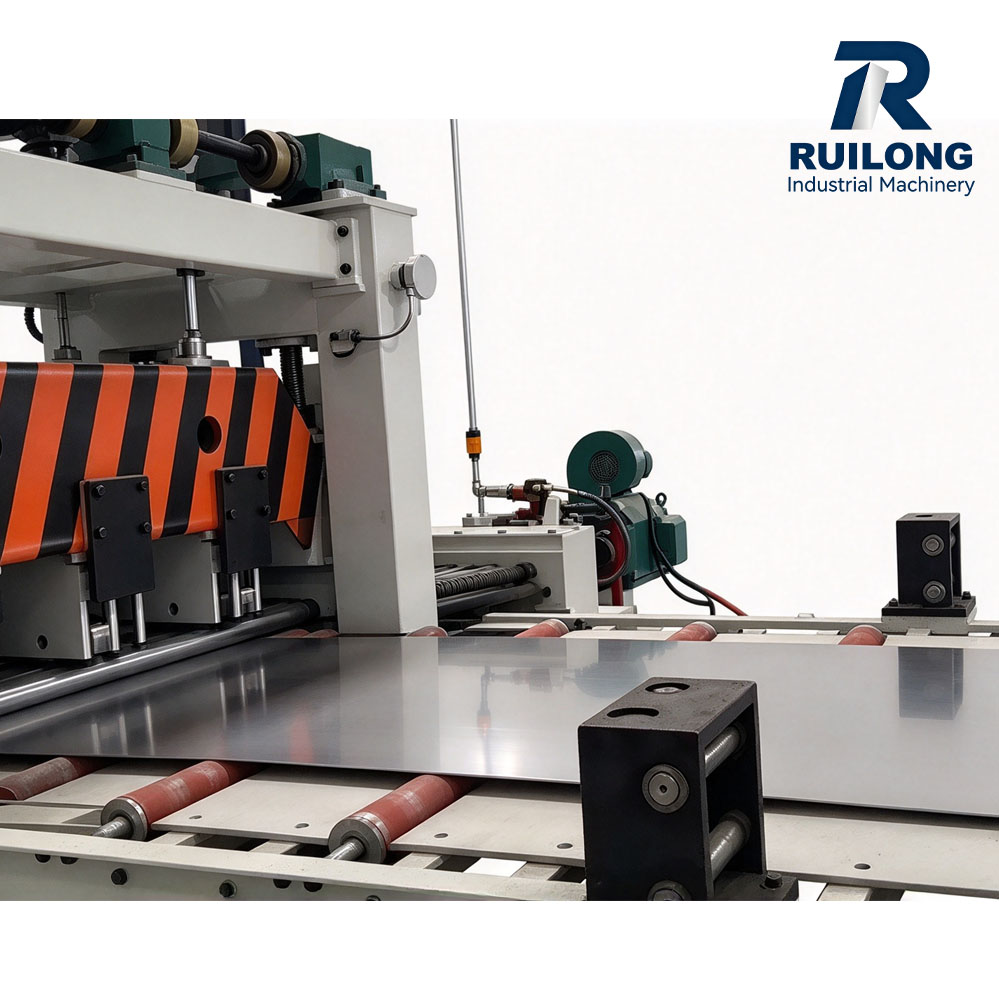
1. Three Suspects, Three Fingerprints
Every drift complaint should be split into three samples first — ten sheets from the start, middle and end of a coil — because the pattern across the coil is the diagnosis. The fingerprints:
|
Suspect |
Drift signature |
Physical cause |
|
Encoder wheel |
Proportional offset (every sheet off by the same %) |
Wheel diameter changed by wear, coating buildup or calibration entry error |
|
Pinch roll slip |
Random scatter, sheets both long and short |
Feed force exceeds grip: low pinch pressure, oiled strip, worn roll surface |
|
Back tension |
Monotonic drift within a coil, resets next coil |
Strip floats or bows between decoiler and feed; effective length per servo revolution shifts as coil diameter and torque change |
The arithmetic that makes the first suspect primary: a ±1.0mm tolerance on a 2,000mm sheet is 0.05%, and an encoder wheel losing 0.05mm on a 200mm circumference loses exactly that — wear and aluminum-oxide buildup reach that in months, not years. The second suspect is force arithmetic: grip is pinch pressure × friction, and the feed section accelerates strip from standstill every cut — on high-rate lines the peak feed force approaches grip, and any oil film on the strip converts margin into slip, which shows up as pinch roll slipping causing length variation in both directions. The third suspect is torque arithmetic: decoiler torque must hold the strip taut to the feed roll; as the coil pays out from full OD to core, the required torque per wrap changes, and an untuned tension curve lets the strip go slack at one end of the coil — the exact mechanism behind a back tension setting decoiler length accuracy complaint that comes and goes with coil position.
✅ Bottom line: Split the drift across the coil before touching anything — proportional, random or coil-positioned, the signature names the suspect.
2. The Fix Sequence — Cheapest Check First, Verification Last
Run the fixes in order of cost, and verify each with the same thirty-sheet discipline the FAT protocol uses. First, the encoder: measure a known-length master sheet, compare the HMI's counted length against the tape, and correct the wheel diameter entry — a five-minute job that eliminates the proportional offset class, and one Ruilong crews perform at every material changeover as standard practice. Second, the pinch roll: raise pinch pressure to the specified gauge reading, inspect the roll surface for glazing (a shiny roll is a slipping roll — regrit or replace), and check that threading practice keeps oil off the feed path, because a wiped strip and a glazed roll together defeat any pressure setting the gauge can show. Third, the back tension: tune the decoiler torque curve so tension holds constant from full OD to core — most modern controls compensate automatically, and the check is watching strip flatness into the feed roll at both ends of a coil, which Ruilong demonstrates to the crew during commissioning so the check survives turnover.
The verification step is where drift fixes are usually lost: after any correction, run the three-sample test again — start, middle, end — and only then return the line to production. Ruilong writes the three-sample test and the torque-curve check into the commissioning checklist precisely because drift complaints are seasonal: they return with new material suppliers, new lubricants and new operators unless the verification habit stays. The habit costs ten minutes and closes every loop this tree opens. The relationship to the rest of the line is worth stating once: drift beyond ±1.0mm on long sheets also shows up as diagonal error at the shear, so a length-drift complaint that survived this tree should continue on the squareness path in the diagonal article.
✅ Bottom line: Encoder first, pinch second, tension third — verify with three samples after each fix, or the drift returns with the next lubricant.
FAQ
Q: How often should the encoder wheel be recalibrated? A: Monthly against a master sheet, and after every strip change that introduces abrasive oxides — wheel diameter drift is silent, and the proportional-offset signature only appears once the error exceeds a few tenths of a percent.
Q: Why does pinch roll slipping causing length variation get worse on oily strip? A: Grip is pressure times friction, and oil cuts friction directly — the feed force that barely held on dry strip slips at every acceleration peak, so the fix is pressure to spec plus a glazed-surface regrit, not just more pressure.
Q: Can a back tension problem cause diagonal errors instead of length errors? A: Yes, indirectly — slack strip enters the shear at an angle, which is the squareness mechanism in our diagonal article; when a cut to length line length drift troubleshooting tree resolves the length but the diagonals stay wide, hand the complaint to the tracking and camber checks there.
Get the Diagnostic Tree With the Line
Send Ruilong your tolerance bands and material list, and the engineering team will return the drift diagnostic tree — three-sample test, torque-curve check and master-sheet procedure — with the line offer from our China factory: as the manufacturer behind Tai'an Ruilong Machinery Co., Ltd., we quote supplier/OEM-direct with the commissioning checklist attached, free of charge and without obligation. The custom checklist is built for your materials, not the average.