
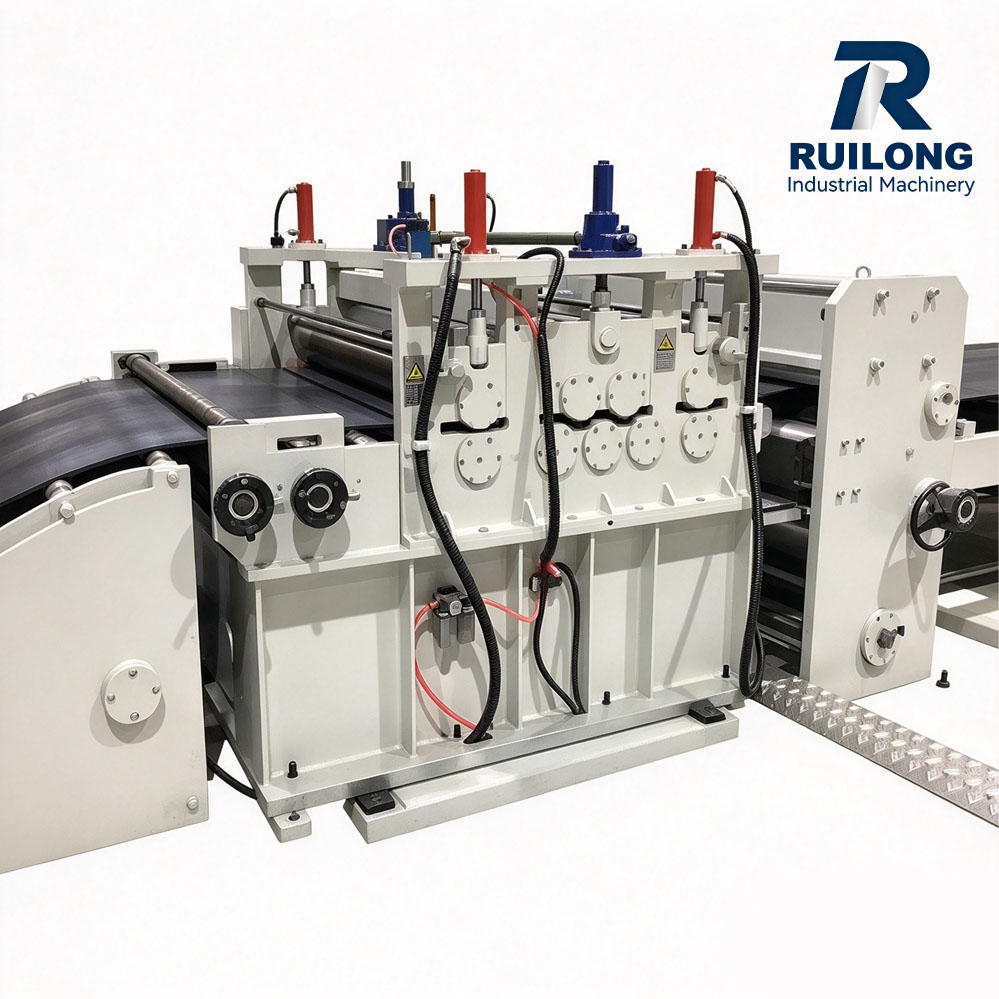
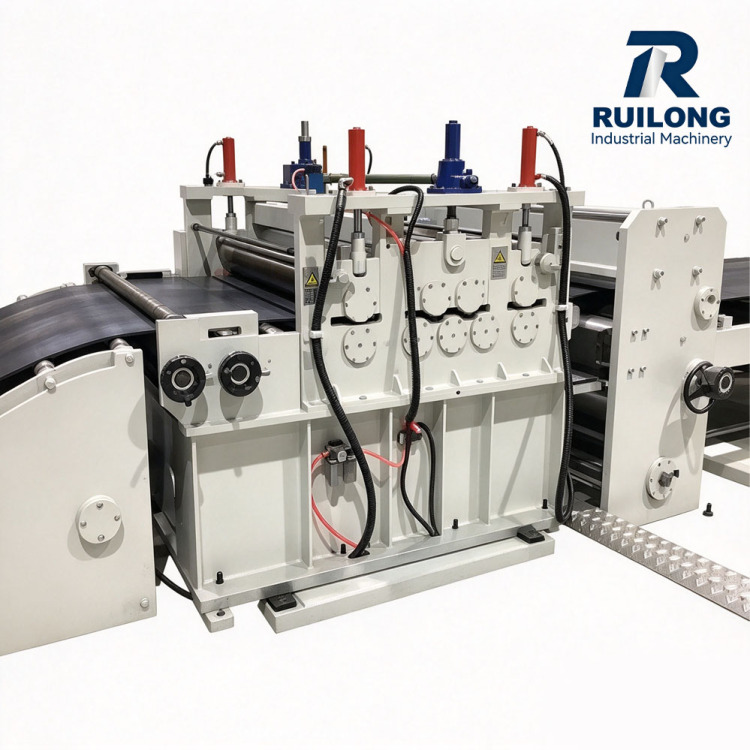
1. Three Cutting Kinematics — and What Each One Buys
The shear mechanism is not a component choice; it is the boundary of the blank shape catalogue. A start-stop straight shear stops the strip, cuts, and restarts — the cut is always perpendicular to the edges, so every blank is a rectangle. A swing shear carries its blade carriage through an arc synchronized with the moving strip: the blade meets the sheet at an angle, cuts on the fly, and returns — so the cut line can be inclined, which is the enabling geometry for trapezoid and parallelogram blanks without a second trim press. A laser blanking cell abandons the blade entirely: a fiber laser follows any contour, and nesting software fills the sheet almost edge to edge.
|
Criterion |
Start-stop straight shear |
Swing shear |
Laser blanking |
|
Blank shapes |
Rectangle only |
Rectangle, trapezoid, parallelogram |
Any contour |
|
Typical yield on a hood-type blank |
88–92% |
91–95% |
95–98% |
|
Sustained rate |
25–40 stops/min |
30–45 cuts/min, no stop cycle |
8–15 blanks/min, contour-dependent |
|
Blank edge |
Sheared, burr ≤10% of gauge |
Sheared, comparable quality |
Thermal, thin recast zone, no burr |
|
Capital index |
1.0 |
1.3–1.6 |
3–4 |
|
Tooling |
Blades, regrind cycle |
Blades, arc path spreads wear |
Nozzle + lens consumables |
The swing shear's less advertised benefit shows up in the drive train: because the cut happens during motion, the strip never accelerates from standstill — the start-stop cycle is where drive size, strip stretch and length-tolerance drift all live. For a trapezoidal blank cutting line for car body panels, that means angle and length accuracy arrive together instead of trading against each other.
Ruilong quotes the shear kinematics from the customer's blank drawings first and the tonnage second: the shape catalogue in the drawings decides the mechanism, and everything else — drive size, feed accuracy, stacker — is downstream of that choice.
✅ Bottom line: The shear mechanism defines the blank shape catalogue — rectangle, trapezoid or any contour — and yield follows the catalogue.
2. The Yield Arithmetic: When Each Mechanism Pays
Material yield only converts into money when it is divided by installed cost — which is why the cut to length line vs laser blanking material yield decision is volume-dependent. Work the same hood-type blank through the three mechanisms on a line fed with 1.2mm high-strength coil:
- Straight shear at 90% yield: every ton of coil yields 900 kg of blanks. Simple, lowest capital — the default when the product mix is genuinely rectangular.
- Swing shear at 92.5%: the trapezoid recovers trim that the rectangle version drops as skeletal scrap. Two and a half points of yield on 100,000 t/yr of input is 2,500 t of steel not bought — at US1.75 million a year, against a capital premium of one-and-a-half indices.
- Laser blanking at 96.5%: another four points on top, worth about US$2.8 million a year at the same volume — but the capital index triples and the sustained rate drops by half or more, so the cell needs either higher value blanks (AHSS outer panels) or multi-shift saturation to amortize.
The crossover discipline: below roughly 150,000 blanks per year with simple shapes, the straight shear wins on capital; between 150,000 and 500,000 with trapezoid-prone panels, the swing shear collects the yield at acceptable cost; above that, or wherever contours and AHSS scrap values dominate, laser blanking closes the gap. The second-order factor is flexibility — body programs change, and a laser cell re-nests with software while a swing shear re-nests with mechanical limit changes — which is why Tier 1s running five panel types on one line increasingly pay the laser premium for changeover alone.
Ruilong supplies both swing-shear CTL lines and laser blanking cells, and builds the two-technology comparison into the quotation when the customer's program mix straddles the crossover — including the skeletal-scrap sell-off revenue, which slightly flatters the CTL route and belongs in the arithmetic rather than in footnotes.
✅ Bottom line: Yield points are real money at volume, but divide them by capital index and rate — swing shear wins the trapezoid middle ground, laser wins contours and AHSS.
FAQ
Q: Does a swing shear degrade blank edge quality compared with a straight shear? A: No — the cut is still a true shear cut with the same clearance discipline, burr under 10% of gauge; on a swing shear cut to length line for automotive blanks duty the arc path actually distributes wear along more blade length, which stretches the regrind interval rather than shortening it.
Q: Can an existing straight-shear CTL line be upgraded to swing cutting? A: Not realistically — the swing carriage, its synchronized drive and the feed control are a different machine architecture; retrofitting costs approach a new machine, so the upgrade question is really a replacement question and should be evaluated as one.
Q: What yield gain justifies a trapezoidal blank cutting line for car body panels? A: Two yield points sustained over the program life — on typical Tier 1 volumes that pays the swing-shear capital premium back inside two to three years, which is why Ruilong asks for the blank drawings and annual volume before recommending any mechanism.
Compare the Three on Your Own Blank Drawings
Send Ruilong your blank drawings, annual volumes and material grades, and the engineering team will return the three-technology yield arithmetic with a custom line quote from our China factory: as the manufacturer behind Tai'an Ruilong Machinery Co., Ltd., we quote OEM/supplier-direct with the scope itemized, free of charge and without obligation.