
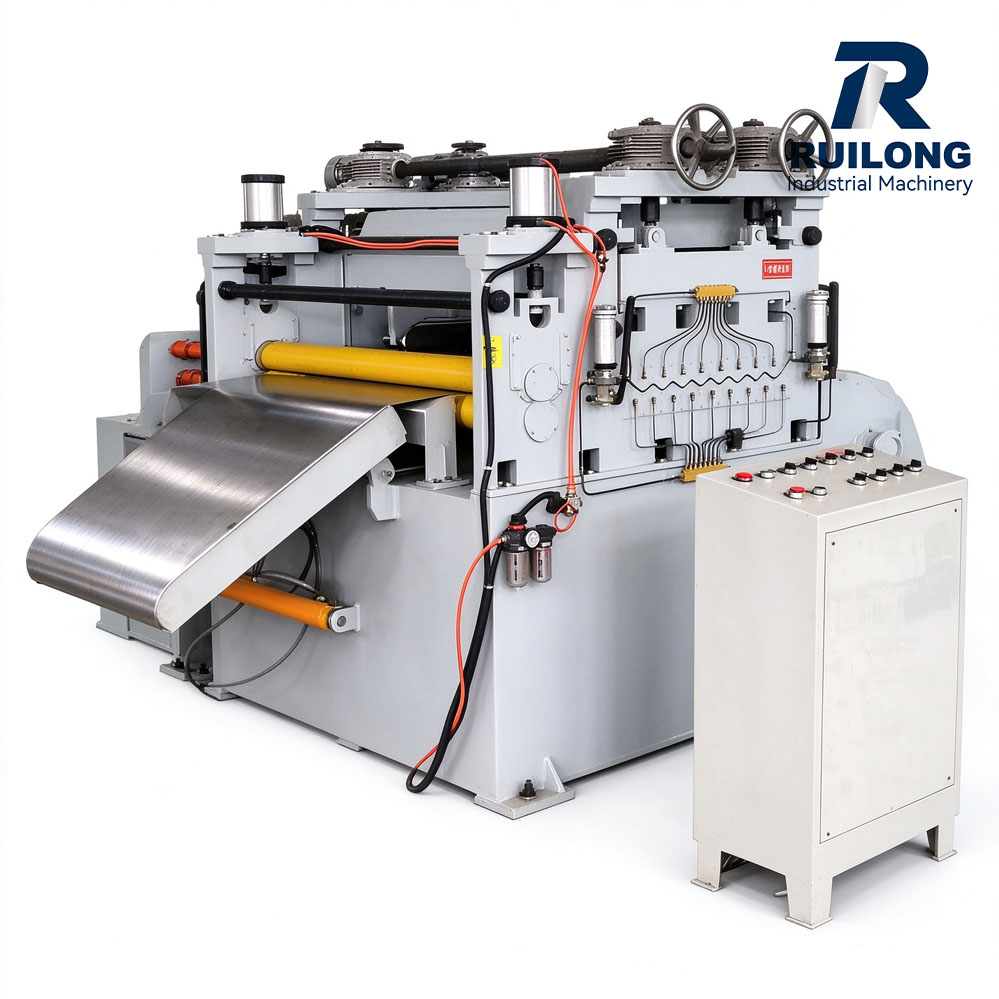
Short answer: appliance buyers rarely write the flatness number down, which is how "it must be flat" turns into rejected batches. The hidden metric behind every such requirement is flatness tolerance in millimeters per linear meter — how far the surface deviates from a straightedge over one meter — measured at 24 hours, because a freshly leveled sheet is still moving. For visible refrigerator side panels the working figure is ≤1 mm/m; for structural members it relaxes to 2–4. This article pins those numbers — the spec usually travels as flatness tolerance mm per square meter after leveling, so know which unit you are buying — and explains the machine decisions behind them, in the order Ruilong sequences them at quotation: why a six high leveler for appliance panel flatness exists at all, and how center buckle and edge wave elimination on thin sheet are two different knob turns, not one.
1. The Tolerance Ladder — and Why 24 Hours Is Part of the Number
Flatness without a measurement method is not a specification; it is a mood. The ladder below is what appliance-grade CTL output is actually judged against, and the measurement discipline matters as much as the number: straightedge over 1 m, on a flat table, at 24 hours after cutting.
|
Application |
Typical gauge |
Flatness limit |
Measured how |
|
Visible outer panel (refrigerator, washer side) |
0.5–0.7 mm CR |
≤1 mm/m |
Straightedge 1 m, 24 h |
|
Inner liners and CMC panels |
0.4–0.6 mm CR |
≤2 mm/m |
Straightedge 1 m |
|
Backing and mounting plates |
0.8–1.5 mm |
≤3 mm/m |
Straightedge 1 m |
|
HVAC and duct blanks |
0.5–1.2 mm |
≤3–5 mm/m |
Straightedge 1 m |
Why 24 hours belongs in the spec: leveling stores a surface-to-core stress gradient, and the sheet relaxes it over hours — a panel flat at the stacker can show edge wave the next morning, exactly the mechanism our overnight-waves article documents. A buyer who measures at shift end and a supplier who measures at 24 hours will disagree about the same batch; the acceptance sheet must name the clock, and the mill certificate's I-units — a different unit system entirely — should be converted before any comparison, not eyeballed against a straightedge number.
One more trap lives in the phrase "mm per square meter": flatness is measured along a line — deviation from straight over a linear meter — not over an area. Specs that travel as mm/m² invite the two interpretations to collide at acceptance. Ruilong writes the linear definition, the straightedge length and the 24-hour clock into the acceptance sheet of every appliance line, so the buyer's QC and the supplier's QC are reading the same sentence.
✅ Bottom line: A flatness number without method is a mood — pin the limit, the straightedge length, the clock at 24 hours and the unit before the first batch ships.
2. Center Buckle vs Edge Wave — Two Knobs, Not One
Center buckle and edge wave look like the same problem to a buyer and are opposite diagnoses to a leveler. Both are elongation mismatch: the fibres that ended up longer than their neighbors have to relieve somewhere, and they wave. Center buckle means the middle fibres are longer than the edges; edge wave means the opposite. Adding penetration — the reflex fix — treats edge wave and worsens center buckle, which is how a flat sheet on trial becomes a wavy one in production.
|
Symptom |
Elongation diagnosis |
First knob |
|
Center buckle (waves mid-width) |
Center fibres longer |
Crown / intermediate roll bending — flatten the pressure profile at center |
|
Edge wave (waves at edges) |
Edge fibres longer |
More penetration; check entry tension |
|
Both at once |
Tension or grade mismatch |
Verify tension system before touching the leveler |
|
Twist |
Rolls not parallel |
Roll parallelism check before any intermesh change |
This is the reason the six high leveler for appliance panel flatness exists: a conventional four-high stack adjusts penetration globally, so it can trade center buckle for edge wave but not eliminate both, because it has one knob for a two-dimensional problem. A six-high adds intermediate rolls between the work rolls and backup rolls, and those intermediates bend or shift to shape the pressure profile across the width — flattening the center without over-bending the edges. On 0.5mm CR at 1,200 mm width, that is the difference between holding ≤1 mm/m across the full width and holding it only somewhere.
Center buckle and edge wave elimination on thin sheet therefore belongs in the machine selection decision, not the operator training plan: if the order book is wide thin visible-panel stock, the leveler must be six-high (or a four-high with crown control), because no amount of diligence turns one knob into two. Ruilong sizes this from the gauge-width map at quotation, and the same logic extends to the acceptance discipline — first piece measured at all three positions (center, quarter, edge), not just center.
✅ Bottom line: Buckle and wave are opposite elongation diagnoses — a four-high trades one for the other, and only crown control eliminates both on thin wide stock.
FAQ
Q: Are I-units on the mill certificate the same as mm/m? A: No — I-units are a different (dimensionless) unit system used in mills, and a straight conversion is easy to get wrong under acceptance pressure; also beware the flatness tolerance mm per square meter after leveling phrasing, which invites an area reading — specify flatness in mm per linear meter with a straightedge method, and convert any certificate value into that unit before comparing.
Q: Why does a four-high leveler fail on thin wide appliance stock? A: Because it has one penetration knob for a two-dimensional elongation problem — fixing center buckle by more penetration makes edge wave worse and vice versa; the six-high's intermediate roll bending shapes the pressure profile across the width, which is what ≤1 mm/m across the full width actually requires.
Q: Can wavy side panel blanks be reworked? A: Only by re-leveling off-line — every additional leveling pass costs handling and risks the surface, so the economic answer is holding the metric at the line with first-piece measurement at center, quarter and edge, which Ruilong builds into the standard operating sheet.
Pin Your Flatness Number Before the First Batch
Send Ruilong your gauges, widths and visible-panel grades, and the engineering team will return the tolerance ladder, leveler selection and a custom line quote from our China factory: as the manufacturer behind Tai'an Ruilong Machinery Co., Ltd., we quote supplier/OEM-direct with the scope itemized, free of charge and without obligation.