
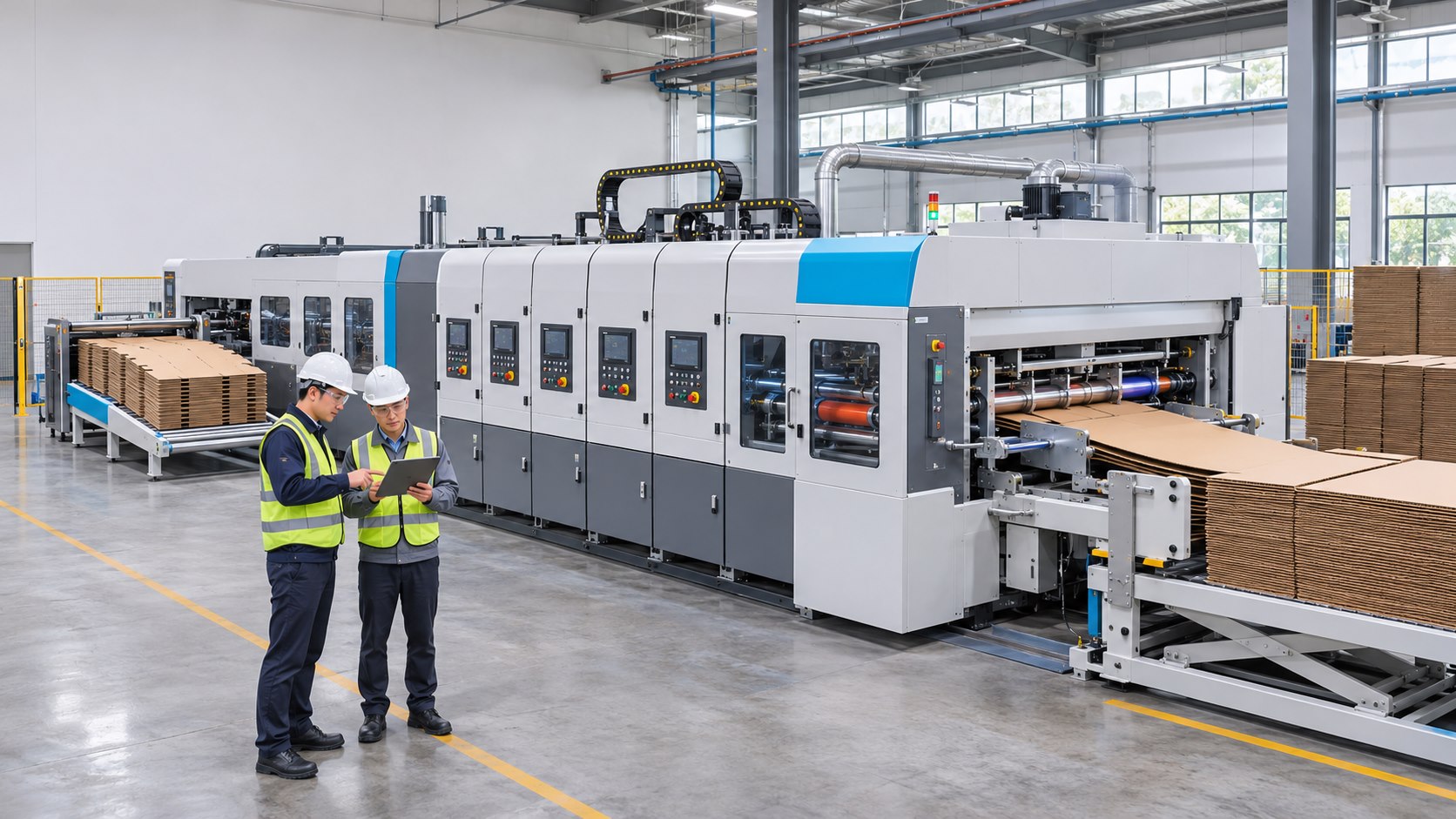
A corrugated box machine cost comparison should begin with the production route, not a single headline price. Two quotations may describe similar equipment but include different printing units, transfer systems, slotting or die-cutting sections, automation levels, installation scope and acceptance conditions. Buyers get a clearer decision when they compare what each configuration must produce, how it will be verified and what remains outside the quotation.
Why Machine Price Alone Can Mislead
A lower initial quotation can become difficult to compare if essential modules, tooling, transport preparation, commissioning or operator training are listed separately. A higher quotation may include more automation than the plant can use. Neither conclusion can be reached from the total alone. The useful question is whether the proposed line matches the jobs the factory plans to run and whether the scope is complete enough to reach accepted production.
Create one requirement sheet for every bidder. Use the same sheet sizes, board grades, color count, slotting and die-cutting needs, target order types, available utilities and factory constraints. Ask suppliers to mark included, optional and excluded items. This exposes genuine configuration differences without treating unlike quotations as equivalent.
9 Factors That Shape Corrugated Box Machine Cost
1. Board and Sheet Range
Maximum and minimum sheet dimensions, flute combinations, board thickness and warp tolerance influence feeder, transfer and converting requirements. Provide representative sheets instead of only nominal sizes. A machine selected around the largest box may be inefficient for frequent small jobs, while a compact configuration may not support the plant's future order range.
2. Printing Configuration
The number of print units, required print coverage, ink system, plate handling and register controls all affect scope. Separate process requirements from preferences. A factory producing simple shipping cases may prioritize stable setup and repeatability; high-graphic work may require a different discussion about transfer, ink control and inspection.
3. Feeding and Board Transfer
Feeder design and transfer method should match the board condition and print work. Ask how warped or variable sheets are handled, how the operator recovers from a misfeed and how board contact is controlled through the line. These details affect usable production and should be demonstrated during trials rather than inferred from a brochure.
4. Slotting, Creasing and Die-Cutting Scope
A printer, a printer-slotter and a printer-slotter-die-cutter are different investment scopes. Confirm whether rotary die cutting, waste removal, creasing adjustments, tool mounting aids and sample tooling are included. List the box styles and dimensional checks required for acceptance so that converting capability is evaluated on real work.
5. Servo, PLC and Job Memory Functions
Automation should be tied to a repeatable task. Ask which axes are servo controlled, which settings can be stored, which parameters are recalled and which still require manual verification. Job memory can support repeat orders, but it does not replace controlled plates, dies, ink, board and approval procedures.
6. Delivery, Counting and Downstream Handling
The output section must deliver the count, orientation and stack condition needed by the next process. Compare basic delivery, stacking, counter-ejector or integrated folding and gluing requirements separately. A fast front end does not create more shipped boxes if bundles accumulate or require extensive manual rehandling.
7. Tooling, Spares and Consumables
Clarify the initial supply of anilox rolls, printing plates or plate-mounting items, dies, slotting tools, belts, brushes, filters, lubricants and recommended spares. Request part descriptions and quantities. A complete list makes first-year planning more reliable without assuming a maintenance cost that has not been supported by operating data.
8. Installation, Training and Factory Readiness
Confirm who handles unloading, positioning, foundations, power, compressed air, exhaust, networking, safety interfaces and waste routes. Define the number of installation and training days, the skills expected from the buyer's team and any travel or local-service exclusions. Factory preparation can affect the schedule even when the machine itself is ready.
9. Acceptance Method and Support Scope
A quotation becomes easier to evaluate when performance is linked to agreed materials and tests. Define the sample jobs, board condition, print and converting checks, restart procedure, repeat-order recall and documentation required at factory acceptance. Also record warranty scope, remote support, service response process and parts identification.
Use a Like-for-Like RFQ Table
Production requirement: sheet range, flute and board condition, color count, box styles, order mix and required downstream format.
Included equipment: feeder, print units, slotter, die cutter, waste handling, delivery, controls, guarding and interfaces.
Project scope: tooling, spares, packing, transport boundary, installation, utilities, training, documentation and support.
Acceptance evidence: agreed board, trial jobs, quality checks, repeat setup, recovery test and signed records.
Compare the Cost of the Required Production Route
For printing, slotting and die-cutting in one route, review the flexographic printing and rotary die cutting category. If the order mix requires folding and gluing after printing, compare the interfaces and handling needs of a flexo folder gluer machine. Buyers evaluating print-only or modular options can also review Taiyi's flexo printing machine range.
The right comparison is not the cheapest machine name. It is the configuration that covers the confirmed work, fits the site, provides a clear acceptance path and makes exclusions visible before an order decision.
Comparing Corrugated Box Machine Quotations?
Share your board range, box styles, print colors, required processes, factory conditions and acceptance samples for a configuration-focused discussion.
Contact T-ONE