
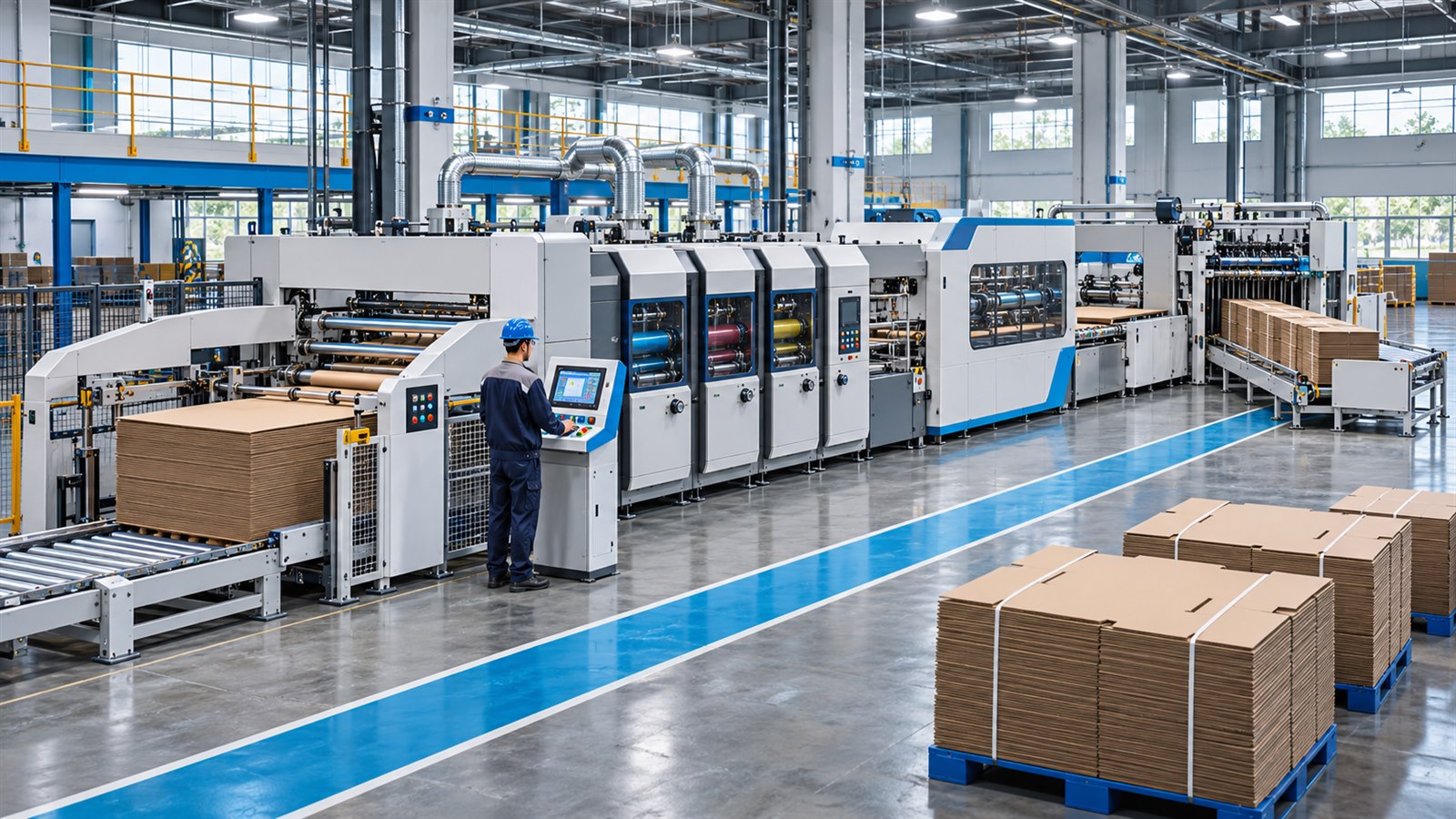
Corrugated box line automation is most effective when it solves a measured production constraint. Adding a faster machine to one process does not guarantee more finished boxes if the feeder starves, changeovers are delayed, bundles queue at delivery or finished goods cannot leave the line. A useful automation plan therefore starts with the flow from incoming sheet to stable stack.
Measure Flow Before Selecting Equipment
Map a normal shift using actual order data. Record when the line is producing, waiting, setting up, cleaning, clearing jams or moving finished bundles. Separate a machine stop from an upstream or downstream wait. This reveals whether the constraint is speed, changeover, material handling, quality approval or information.
Use ranges rather than one ideal job: minimum and maximum sheet size, board grades, print colors, slotting and die-cutting work, order quantities and bundle rules. Automation must handle the mix the plant sells, not only the easiest repeat order.
9 Bottlenecks From Feeder to Stacker
1. Sheet Presentation at the Feeder
Warp, uneven stacks, damaged leading edges and inconsistent replenishment can starve the line before printing begins. Define stack condition, loading method, board range and the time available for replenishment. A pre-feeder decision should include operator access and recovery from a misfeed, not only nominal capacity.
2. Job Information and Setup Readiness
The machine may be ready while plates, dies, ink, board or approved files are not. Create a release checklist with clear ownership and a cutoff time before the scheduled run. If the line stores order settings, verify which parameters are recalled, which must be checked, and how revisions are controlled.
3. Changeover Sequence
Observe every step from the final good sheet of one job to the first approved sheet of the next. Mark tasks that can occur while the press runs, tasks that require a stop, and tasks waiting for another person. A repeatable sequence often creates more usable capacity than increasing top speed on a high-mix schedule.
4. Printing Stability
Feeding, board transfer, ink condition, plate condition and register approval can all limit sustained output. Define how operators recognize drift and when they slow or stop the line. Stable production at an approved condition is more valuable than a short peak that creates inspection holds or rework.
5. Slotting and Die-Cutting Readiness
Tool condition, mounting, waste removal and dimensional checks must be ready for the scheduled job. Identify repeated stops caused by trim, loose waste, worn tools or unclear setup references. Include safe access and maintenance time when comparing converting configurations.
6. Quality Approval Delay
If production waits for a sample to reach a supervisor or lab, the approval loop is part of line capacity. Define which checks occur at the machine, which require escalation and what evidence is retained. Clear acceptance standards reduce disagreement and prevent the line from producing a large quantity before a defect is recognized.
7. Counting, Bundling and Stack Formation
Delivery equipment must create the count, orientation and stack quality required by the next process. List bundle sizes, stack height, tie or pallet rules and special handling for weak or irregular boxes. A line that produces sheets faster than it can form acceptable bundles simply moves the queue downstream.
8. Finished-Goods Removal
Check conveyor space, pallet availability, forklift routes, scan points and warehouse handoff. Finished stacks should leave without blocking the operator's access or creating a safety conflict. For a future automation stage, document the required interface and stack condition even if handling remains manual today.
9. Stop Recovery and Ownership
Every automatic sequence needs a clear recovery procedure. Define what the operator can reset, what requires maintenance, how partially processed sheets are handled, and how the next unit knows the line is ready. Recovery time and fault clarity should be reviewed during a factory acceptance test.
Build a Capacity Map
For each process: normal sustained rate, changeover time, planned checks and common stop causes.
For each handoff: buffer size, bundle format, signal, operator task and recovery method.
For each order family: board range, print and converting work, batch size and required finished-goods condition.
Discuss the Whole Production Route
Taiyi's corrugated board production line category includes equipment for feeding, printing, slotting, die-cutting and stacking arrangements. Plants that also need folding and gluing can review the flexo folder gluer machine category. The appropriate layout depends on confirmed board, job, floor-space and output requirements; one configuration should not be assumed to fit every factory.
A strong request for quotation should include the current flow map, the measured constraint and the acceptance method for the proposed change. This keeps the automation discussion focused on usable production and operator control rather than isolated headline speed.
Planning an Integrated Corrugated Box Line?
Share your sheet range, order mix, required processes, stack format and current bottleneck for a more relevant equipment discussion.
Contact T-ONE