
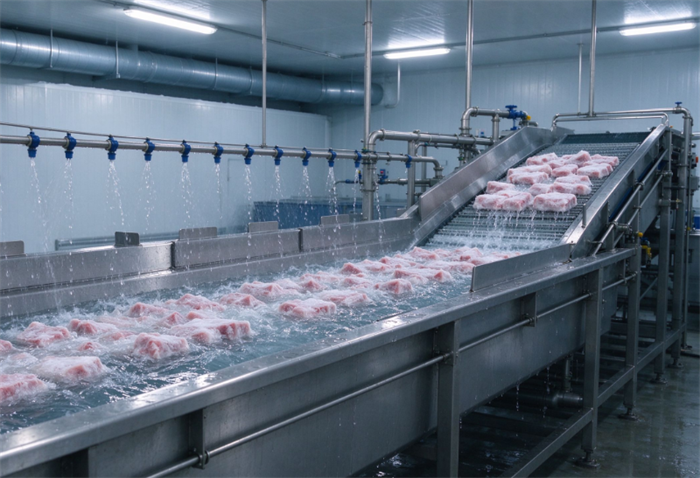
Thawing is the first procedure in meat product processing. It directly determines the water-holding capacity and yield of raw materials, as well as microbial safety. It also greatly impacts factory energy consumption and production efficiency. Three mainstream industrial thawing methods — static water thawing, low-temperature high-humidity thawing, and microwave thawing — suit different production capacities, raw material characteristics and quality positioning. Many enterprises suffer from low yield, excessive microbial counts and high energy costs due to improper process selection.
I. Core Evaluation Indicators for Thawing Processes
The suitability of a thawing process shall be assessed comprehensively based on six key metrics:
Drip loss rate: Directly linked to yield, it is the primary economic indicator.
Degree of protein denaturation: Affects the process performance of subsequent marination, tumbling and emulsification, and defines the final texture of finished products.
Microbial growth level: Determines the initial microbial load of raw materials, and directly influences the shelf life of end products and food safety risks.
Thawing uniformity: A smaller temperature difference between core and surface ensures more consistent processing outcomes.
Energy consumption & efficiency: Water, electricity and gas cost per unit of raw material and thawing cycle, which govern capacity compatibility.
Capital investment & adaptability: Equipment procurement cost, footprint and the range of applicable raw materials.
II. In-Depth Breakdown of Three Mainstream Thawing Processes
1. Static Water Thawing: Traditional Low-Cost Solution
Static water thawing uses water as the heat transfer medium to deliver heat to frozen meat via convective heat exchange. It includes submerged static thawing and running-water thawing. Food production codes prefer running-water thawing; prolonged static immersion carries substantial microbial risks. This process serves as the basic option for small and medium-scale producers.
Working Principle Heat transfer relies on the temperature difference between water and the frozen meat surface, gradually melting ice from the outside in. The running-water variant maintains stable water temperature via continuous water replacement. It thaws faster than static immersion and reduces microbial accumulation in water.
Impacts on Meat Quality
Drip loss: Moderate. For standard 25 kg frozen meat blocks, drip loss normally ranges from 2% to 5%. If water temperature is high or thawing takes too long, surface tissue soaks for extended periods after thawing, damaging myofibrillar structures and pushing drip loss higher.
Protein & flavour: Water-soluble proteins and minerals on the surface leach into the water, reducing salt-soluble protein content and weakening subsequent water-holding and emulsifying properties. Extended immersion also dilutes the native meat flavour.
Microbial risk: High. When water temperature exceeds 15°C, microbes multiply rapidly in the thawed surface layer. Static water easily becomes a vector for cross-contamination. Thawing different raw material types in the same pool sharply increases contamination risks from Pseudomonas and coliforms.
Uniformity: Large temperature gradient between surface and core. The surface may be fully thawed while the centre remains frozen, often leading to over-thawing of outer layers.
Energy Consumption & Efficiency
Operating cost: Direct energy use is minimal; water expense is the main cost. Running-water thawing consumes large volumes of water. When yield loss is factored in, the overall cost rises markedly. If chilled water systems are deployed, energy consumption climbs significantly.
Thawing efficiency: Long cycle. A standard 25 kg frozen block takes 8–12 hours for running-water thawing at ambient temperature, or 12–24 hours for static immersion.
Pros and Cons
Advantages: Almost zero equipment investment, low operational barrier, compatible with raw materials of all shapes.
Disadvantages: Substantial yield loss, high microbial risk, heavy water waste, unsuitable for large-scale standardized production.
2. Low-Temperature High-Humidity Air Thawing: Mainstream Upgrade Option for the Industry
Low-temperature high-humidity thawing is the preferred process for bulk raw materials at leading meat manufacturers and the key upgrade alternative to static water thawing.
Working Principle Inside an enclosed thawing chamber, a refrigeration system maintains a low-temperature environment of 0–4°C, while a humidification system keeps relative humidity at 90%–95%. Uniform circulating airflow enables stable heat exchange. Slow thawing near the freezing point of meat minimizes internal-external temperature difference and cuts drip loss and dehydration loss.
Impacts on Meat Quality
Drip loss: Excellent performance. Drip loss for standard 25 kg blocks can be controlled at 1%–3%. Yield improves by 1–2 percentage points versus running/static water thawing, delivering distinct economic benefits. The high-humidity environment suppresses surface moisture evaporation, so dehydration loss during thawing is negligible.
Protein & texture: Under consistent low-temperature conditions, myofibrillar protein structures remain intact with very low denaturation. Raw materials retain strong water-holding and binding properties for stable tumbling and marination results downstream.
Microbial risk: Very low. The 0–4°C environment inhibits the proliferation of most microbes except psychrophiles, keeping initial microbial loads low and supporting longer shelf life for finished goods.
Uniformity: High thawing uniformity. For large meat blocks, the temperature gap between surface and core at the thawing endpoint can be limited within 2–3°C with no obvious over-thawed surface, ideal for standardized cutting and further processing.
Energy Consumption & Efficiency
Operating cost: Moderate energy consumption, mainly for refrigeration, humidification and air circulation. If only electricity consumption is counted, it is comparable to chilled static water thawing. When full-lifecycle costs (energy, water and yield loss) are considered, it outperforms chilled water thawing by a wide margin.
Thawing efficiency: Moderate cycle. A standard 25 kg frozen block with an initial core temperature of -18°C takes 12–18 hours to reach a semi-frozen state at -2°C core temperature. Batch thawing overnight for next-day production fits continuous production schedules.
Pros and Cons
Advantages: High yield, stable quality, reliable microbial safety, suitable for continuous bulk raw material processing.
Disadvantages: Higher capital outlay than water thawing, larger footprint, not fit for tiny batches or rush orders.
3. Microwave Thawing: Efficient Flexible Supplementary Solution
Microwave thawing is a rapid thawing technology. High-frequency electromagnetic fields drive polar vibration and friction of water molecules inside raw materials to generate heat for synchronous bulk heating. It is mostly applied to high-value raw materials and emergency orders.
Working Principle Industrial 915 MHz microwaves achieve a half-power penetration depth of 10–20 cm into frozen meat. Heating proceeds synchronously from inside out without relying on conductive media. Domestic 2450 MHz microwaves have shallow penetration and only suit small cuts.
Impacts on Meat Quality
Drip loss: Best results under well-controlled parameters, with drip loss as low as 0.5%–2%. However, excessive power or overlong exposure pushes local temperature above 40°C and triggers thermal denaturation of myofibrillar protein, causing partial “cooking”, soaring drip loss and stiff texture.
Protein & flavour: Minimal protein denaturation and full flavour retention with proper operation. Miscontrolled parameters cause localized protein denaturation and undermine subsequent processing performance.
Microbial risk: Lowest risk. The thawing cycle lasts only minutes, leaving almost no time for microbial multiplication. The initial microbial load stays close to that of the frozen state.
Uniformity: Core limitation. Irregularly shaped raw materials tend to have overheated edges while the centre stays frozen. Intermittent thawing and gradient power modulation are required to improve uniformity.
Energy Consumption & Efficiency
Operating cost: High instantaneous power, yet thermal efficiency exceeds 70%. The extremely short cycle brings total electricity consumption per tonne roughly in line with low-temperature high-humidity thawing, and far below chilled running-water thawing.
Thawing efficiency: Extremely fast. A standard 25 kg frozen block reaches semi-thawed condition in just 15–30 minutes, enabling fast response to ad-hoc orders.
Pros and Cons
Advantages: Ultra-fast speed, superior microbial safety, small footprint, low raw material loss. Disadvantages: High equipment investment, strict operational requirements, poor uniformity for irregular cuts, unsuitable for massive continuous production.
III. Clarification of Common Misconceptions
1.Misconception: Static water thawing has the lowest overall cost Fact: Static water thawing has the lowest direct utility cost alone. Once yield loss from dripping, water charges and microbial control expenses are included, its total cost is far higher than low-temperature high-humidity thawing. The disadvantage amplifies as production capacity grows.
2.Misconception: Meat must be fully thawed before processing Fact: The optimal thawing state for meat processing is semi-frozen with core temperature between -2°C and 0°C. This condition facilitates cutting and tenderizing while maximally preserving water-holding capacity. Full thawing above 0°C instead increases drip loss and microbial risks.
3.Faster microwave thawing is always better Fact: High-power continuous rapid thawing easily triggers localized overheating and protein denaturation. Industrial deployment must adopt intermittent modes to allow heat conduction and guarantee uniformity and quality.
4.Air thawing always causes heavy dehydration loss act: Conventional low-temperature air thawing with low humidity creates 1%–2% dehydration loss. Low-temperature high-humidity thawing suppresses surface evaporation with humidity above 90%, limiting dehydration loss below 0.2%, which is practically negligible.
Summary
None of the three processes is universally superior. Enterprises shall select or combine processes according to production scale, raw material features and quality positioning. The industry’s most proven configuration uses low-temperature high-humidity thawing for bulk raw materials, microwave thawing as backup for rush orders and high-value cuts, and properly regulated static water thawing for scattered small lots.