
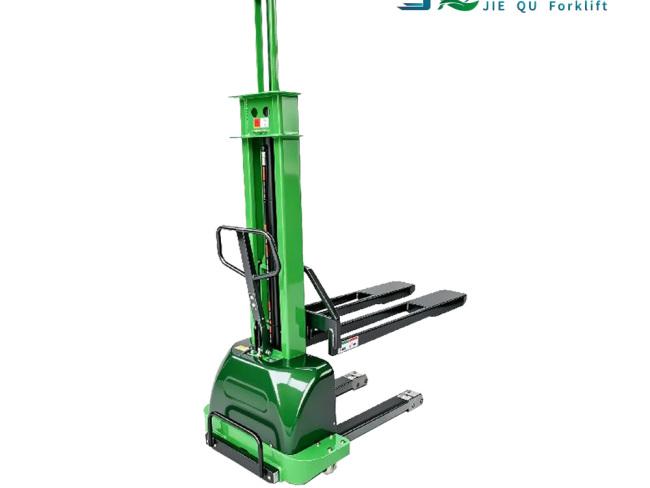

1. What Do Cold Storage Stacker Requirements Actually Change on the Machine?
A freezer-ready stacker differs from a standard one in four systems: battery, electronics, hydraulics and charge strategy — not just the battery sticker. Buyers reviewing cold storage stacker requirements for frozen food warehouse buyers should put each of these lines into the quotation:
- Battery chemistry and charge protection. Specify LiFePO4 with a BMS low-temperature charge lock or, better, a heated pack option. A pack that charges only above 0°C is useless inside a −20°C aisle unless your shift pattern returns it to ambient air regularly — reputable suppliers make the charge lock standard, but confirm it in writing.
- Electronics sealing. A truck exiting a −20°C freezer into an 18°C dock condenses water on every cold surface within minutes. Cold-spec builds use IP54-rated connectors, conformal-coated control boards and drained chassis channels; a standard truck will throw fault codes within weeks.
- Hydraulic oil and seals. Standard ISO VG 46 oil thickens into syrup below freezing and cavitates the pump. Cold builds run low-viscosity oil (ISO VG 15–22) with low-temperature seal compounds on cylinders and valves.
- Mast and rollers. Ice debris and frost build-up between mast channels demand sealed roller bearings and wider chain clearance.
The low-temperature behavior worth memorizing fits one table:
|
Behavior below 0°C |
Lead-Acid |
Lithium (LiFePO4) |
|
Usable discharge capacity at −20°C |
loses 20–40% |
keeps ~80% |
|
Charge acceptance below 0°C |
poor; charge time stretches further |
blocked by BMS unless pack is heated |
|
Cycle life under cold duty |
accelerated sulfation |
minimal impact if charged above 0°C |
|
Charging area |
ventilated room — colder and worse |
any ambient-zone socket |
Ticking every line of the cold storage stacker requirements for frozen food warehouse buyers above adds roughly 10–15% to a standard truck's price, a premium a serious China manufacturer recovers in the first avoided freezer breakdown.
The same physics reaches every machine in the freezer, not only powered ones. Even a Manual Hydraulic Pallet Truck needs cold-rated wheels, seals and hydraulic oil at −25°C — a truck without a battery is not automatically cold-proof, which is exactly why hand equipment fails in freezer aisles first.
✅ Bottom line: Freezer readiness is a four-system spec — battery charge protection, sealed electronics, low-temp hydraulics and mast details — and every one of them belongs in the quotation, not in the brochure.
2. How Do You Keep a Lithium Stacker's Battery Healthy Through Winter Shift Patterns?
Charge it above 0°C every time, and the pack will deliver most of its rated life even in a −20°C warehouse. Lithium cells dislike being charged while cold far more than being discharged while cold, so the winning move is operational, not chemical: how to extend lithium stacker battery life in winter comes down to the charging map. These five rules cover it:
- Charge in the ambient zone. Plan routes so the truck exits the freezer between stints and plugs in at the ambient dock. A 20-minute lunch-break charge at +15°C does more for pack life than any warranty clause.
- Specify a heated pack for freezer-parked trucks. If the truck must charge inside the cold zone, a self-heating LiFePO4 pack with a BMS pre-charge warm-up is the only safe configuration.
- Respect the BMS cutoff. A low-temperature charge lock refusing to charge is a protection feature, not a defect — overriding it voids the pack.
- Store at 40–60% state of charge when a truck sits idle overnight or over holidays, and avoid deep discharges in the cold, where usable capacity is already reduced.
- Budget a winter capacity margin. Even lithium gives up roughly 20% of runtime at −20°C, so size the pack for the coldest shift, not the average one.
Fleet layout does the rest. Trailer-bed transfers between the ambient dock and the freezer airlock belong to a Hydraulic Loading Dock Lift, which never enters the cold zone at all, and a Hydraulic Scissor Lift Table at the blast-freezer load station holds pallets at packing height so the stacker only travels — every minute a battery truck spends outside the freezer is charging-window time earned back. That operating pattern is what turns the lithium pallet stacker for cold storage low temperature performance spec on paper into runtime in the aisle: buyers who set the fleet up this way typically find one cold-spec lithium stacker covers a shift that previously needed two trucks plus a swap battery.
✅ Bottom line: Charging temperature, not discharge temperature, decides lithium battery life in cold storage — map the charge window back to ambient air and the pack will outlive the truck's paint.
FAQ
Q: Does the lithium pallet stacker for cold storage low temperature performance claim hold at −30°C deep-freeze sites?
A: Discharge yes, with the ~80% capacity figure dropping a little further; charging only with a self-heating pack. For −25°C to −30°C aisles, JIEQU specifies the heated-pack build plus IP65-rated connectors, and the truck should still return to ambient air for its main daily charge.
Q: What is the single fastest way to extend a lithium stacker battery's life in winter?
A: Stop charging it cold. Moving the daily and opportunity charges to an ambient-zone socket, or fitting a heated pack, removes the only condition that permanently damages LiFePO4 cells in freezer duty. The phrase "how to extend lithium stacker battery life in winter" has a one-sentence answer: warm charge, cold discharge, moderate storage.
Q: Can lead-acid still work in a freezer if we already own the trucks?
A: It works, at a cost. Expect 20–40% less runtime, much slower charging, accelerated sulfation and a battery room that gets even less pleasant in winter. Many frozen food operators run lead-acid in ambient zones and reserve one lithium truck for the freezer aisles — a mixed fleet that freezes the capital cost at one unit. JIEQU quotes both chemistries on the same wholesale tier, so the split-fleet math is easy to price.
Get a Cold-Spec Configuration Sheet for Your Freezer
Send JIEQU your aisle temperature, shift pattern and charge-zone layout, and the engineering team at Jiangsu Jiequ Forklift Manufacturing Co., Ltd. will return a factory-direct cold-spec configuration — pack heater option, IP rating, oil grade and charge-window plan for your exact freezer. OEM/ODM buyers receive the same sheet with branding and voltage options priced in. Frozen-duty warranty terms are quoted in writing before the order, not after the first winter.
Email:[email protected]
Mobile: +86 13952631966
Website:wwww.jqforklift.com