
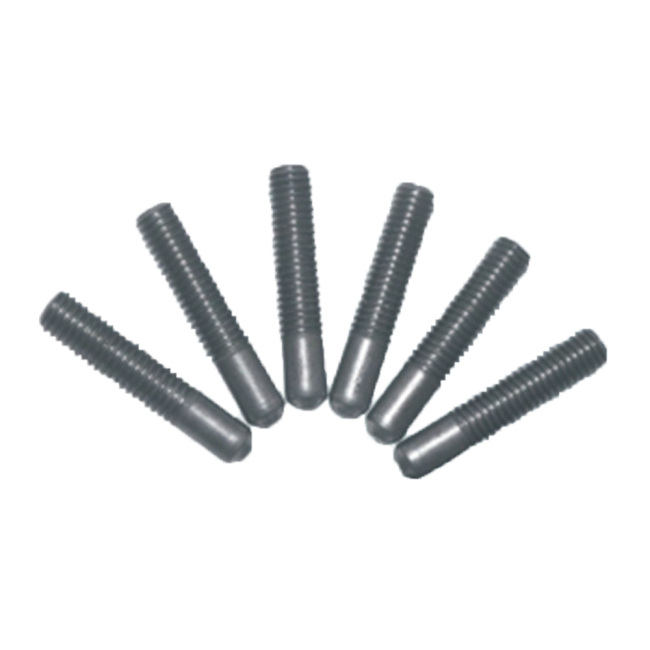

1. Which zinc coatings can actually be welded as supplied?
Sometimes, and the deciding factor is how many microns of zinc sit on the stud face. Up to about 8 µm of electroplated zinc can be welded with parameter compensation; 45–85 µm of hot-dip coating cannot, because there is simply too much metal to vaporise inside a 0.5-second cycle.
|
Finish |
Typical thickness |
Weld as supplied? |
Best route |
|
Hot-dip galvanized |
45–85 µm (325–610 g/m²) |
No |
Strip 25–40 mm around the weld, weld, repair per ASTM A780 |
|
Electroplated zinc |
5–15 µm |
Marginal |
Weld at ≤8 µm with +10% current, then inspect every collar |
|
Zinc flake (binder type) |
8–12 µm |
No |
Binder insulates and outgasses; strip or switch to plain |
|
Plain, oiled |
0 |
Yes |
Degrease only |
|
Copper-plated |
2–3 µm |
Yes |
Best option for capacitor-discharge work |
Thickness decides it, not the word on the certificate. The short answer to can you weld zinc plated studs to steel is that a 6 µm electroplated stud loses its coating in the first 20 milliseconds of the arc and welds almost like plain steel, while a hot-dip stud carries fifteen times that mass and the vapour has nowhere to go. Zinc flake is the worst of the three: the resin binder insulates as well as outgasses, and on zinc flake coated threaded weld studs the arc often refuses to strike at all.
Galvanized decking is the one place where welding through coating is normal practice. Light gauges carry roughly 350 g/m² of zinc against 610 g/m² on a structural beam, and the deck is thin enough that the coating burns back from the arc on its own. That is why shear studs welded through galvanized deck pass site tests while the same stud on a hot-dip beam does not.
✅ Bottom line: Under 8 µm of electroplated zinc can be welded with more current; 45 µm of hot-dip coating has to come off first.
2. Why does zinc plating cause porosity in stud welds?
Because the zinc never joins the weld — it becomes gas. One volume of liquid zinc expands by roughly three orders of magnitude when it vaporises, and stud welding freezes in 0.3–1 second, so the gas is trapped as it rises through a pool that is already solidifying. Those trapped pockets are the porosity you see as a ring of pinholes under the collar.
The sequence is predictable. The arc strikes, the coating nearest the tip boils first, zinc vapour blows a path through the molten metal, and the escaping gas carries droplets out as spatter. The collar then forms over a surface that is partly zinc oxide, which steel does not wet — so you get lack of fusion at the edges even where the collar looks continuous. The answer to why does zinc plating cause porosity in stud welds is therefore physical, not a matter of parameter tuning.
Raising the current makes it worse, not better. More current vaporises more zinc and widens the fume path. Welders who compensate with 15–20% extra current usually get a taller collar with more internal holes, which passes a visual check and fails a bend.
Three routes actually work, and each has a cost.
|
Route |
Where it fits |
Trade-off |
|
Strip 25–40 mm, weld, repair with zinc-rich paint to ASTM A780 |
Structural steel, site work, hot-dip members |
Extra step, repair coat is thinner than the original and needs re-inspection |
|
Weld plain studs, then coat the assembly |
Serial production, panels coated after welding |
Coating line must handle stud threads; masking cost per part |
|
Use copper-plated or plain studs from the start |
Anywhere the stud is the only coated part |
Requires ordering the right finish, not the one in stock |
Strip width is set by the stud diameter and the ferrule seat rather than by convenience, so check the ceramic ferrule sizes matched to each stud diameter before anyone picks up a grinder.
Plan for the fume as well as the weld. Zinc oxide fume has an exposure limit of 5 mg/m³, and welding coated steel in a confined space is a classic route to metal fume fever — flu-like symptoms six hours later, gone in a day, and often blamed on something else. Extract at the arc, not at the ceiling.
Order the finish deliberately, not by default. Most supplier catalogs list zinc-plated as standard because it survives shipping, not because it welds. If the joint is welded and then painted, plain or copper-plated is the cheaper correct answer; if the part must be corrosion-resistant before welding, specify the coating weight and the stripping allowance on the drawing. Buyers who need zinc plated weld studs wholesale from China factory stock should ask for the coating thickness in microns, and treat "galvanized" as a family name rather than a specification. At Jin.Mahuang we quote both finishes and mark the weldable one on the packing list, because a mixed pallet is how cold welds get shipped.
✅ Bottom line: Zinc leaves as gas in under a second; strip hot-dip, cap electroplate at 8 µm, and repair the coating afterwards.
FAQ
Q: Can you weld zinc plated studs to steel without removing the coating?
A: Only thin electroplate, roughly 8 µm or less, and only with more current and visual checks on every collar. Hot-dip coating at 45 µm and above traps gas faster than it can escape, so the weld looks complete and fails in service. Jin.Mahuang supplies the same stud plain, copper-plated or zinc-plated, so the finish can be chosen for the process rather than the warehouse.
Q: What does zinc porosity look like on a finished stud weld?
A: A ring of pinholes under the collar, a collar that sits low and wide, and fine spatter within 30 mm of the stud. Cut one open and you find wormholes along the fusion line. If the collar is full but the bend test still peels the stud, porosity at the interface is the usual cause.
Q: Is galvanized steel harder to weld than painted steel?
A: Yes, because paint burns away while zinc vaporises into the pool, and zinc oxide prevents wetting. Painted steel usually needs the paint removed only where the arc strikes; galvanized steel needs the coating removed across the full weld zone plus a repair coat afterwards.
Send the drawing, get the finish recommendation
Send the stud drawing and tell us what happens after welding — painted, plated, or exposed. Jin.Mahuang replies with the finish we would specify, the stripping allowance if any, and a quotation for the weldable version rather than the default one. Distributors who order zinc plated weld studs wholesale from China factory stock can split a container between plain and plated and keep both lines moving.
Yuyao Zhengfeng Machinery Co., Ltd. has made weld studs, ceramic ferrules and boiler anchor studs in Zhejiang since 2005, holds ISO 9001 and supplies two of China's largest power-plant boiler builders. We run OEM and custom drawings from M6 to M24 in plain, copper-plated and zinc-plated finishes, ship bulk orders with EN 10204 3.1 mill certificates, and match the ferrule to the coating thickness you specify. Ask for a quotation that separates the two finishes — the price gap explains why so many studs arrive plated when they should not be.
Mobile Phone: +86 13857442144
Email: [email protected]