
1. Why the Supplier Structure Is a Technical Decision, Not a Purchasing Detail
The separator and the baghouse share one airflow, one fan operating point and one dust-load budget — so whoever sells them separately is selling half-truths. When the two machines come from two vendors, each datasheet is built on assumptions about the other's resistance, bypass and false-air rate. In practice this produces predictable failures: a fan that surges because vendor A's resistance figure ignored vendor B's ductwork, filter bags blinded in six months because the separator's real bypass was never stated, and a warranty standoff at the duct flange where the two contracts meet.
This is why the single supplier turnkey vs separate vendors dust system procurement risk comparison always lands on the same five rows:
|
Risk Item |
Two Separate Suppliers |
One Turnkey Supplier |
|
Airflow calculation |
Two conflicting assumptions |
One peak-volume calculation |
|
Emission guarantee |
Divided, often void at interface |
Single contractual figure |
|
Commissioning |
Owner coordinates both vendors |
Supplier commissions the circuit |
|
Warranty claims |
Blame shifts at the flange |
One party, one spare-parts list |
|
10-year parts cost |
Two inventories, mismatched kits |
Consolidated bag and rotor spares |
A tail-end Dust Collector bought in isolation can be an excellent machine and still fail in your plant — because excellence at the machine level does not guarantee correctness at the circuit level.
✅ Bottom line: Judge supplier structure the way you judge equipment: by whether one party owns the whole gas path.
2. The 8 Questions to Ask Before You Sign
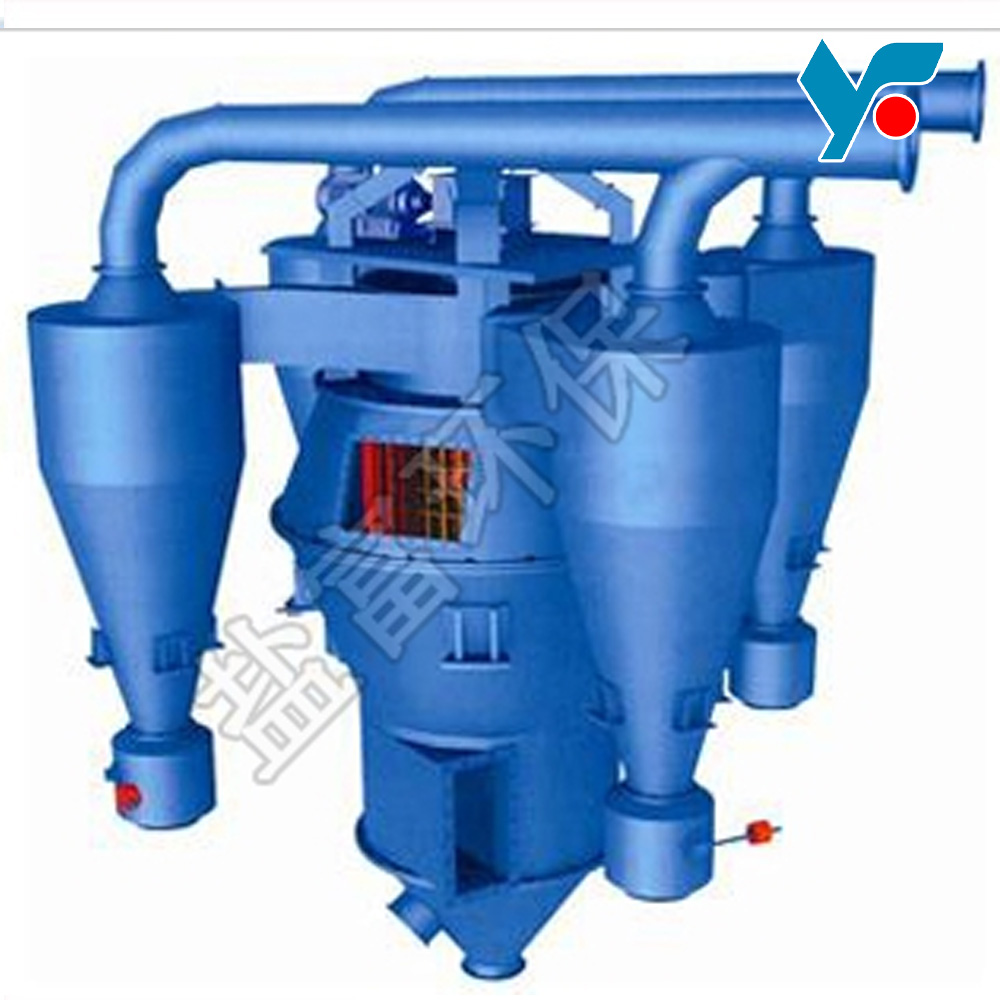
Most procurement damage is preventable with eight questions — ask every bidder, in writing, before comparing prices. These are the essential questions to ask before buying an air separator for cement grinding duty, and they apply equally to the matching filter:
- Will you provide a Tromp curve and measured bypass? If not, the efficiency figure on the datasheet is marketing.
- What inlet concentration did you design the baghouse for, and where did the number come from? It should be derived from the separator's bypass, not a default.
- What air-to-cloth ratio are you quoting, at peak — not average — gas volume? Below 1.2 m/min for kiln-class cement duty is the honest range.
- Who performs the airflow calculation, and does it include false air at 10–15%? One calculation, one owner.
- What exactly does your emission guarantee cover, and at which test point? Look for mg/Nm³ at the stack with a named test method.
- Who commissions the circuit, and is on-site service included? Remote support is not commissioning.
- What is the spare-parts commitment for bags, cages and rotor components? Availability within 72 hours for wear parts is a fair ask.
- Can you show one reference plant where the same pair ran together for 12+ months? Contact the plant, not the brochure.
A supplier who answers all eight in writing is qualified to discuss price. One who dodges the Tromp curve has answered your real question already.
✅ Bottom line: Eight written answers convert a supplier conversation from promises into engineering commitments.
3. The Five Mistakes That Recur in Cross-Border Procurement
Distance amplifies every procurement error, and the same five mistakes appear in project after project. Teams compiling the common mistakes when buying industrial dust collector from China suppliers reports will recognize every one of them — each is avoidable with the questions above:
- Buying on filter area alone. Cloth area is an output, not an input; without the dust-load derivation behind it, 6,000 m² from one bidder and 7,000 m² from another tell you nothing about who is right.
- Accepting "suitable for cement" as a specification. Coal-mill duty needs antistatic bags and explosion venting; lime-kiln duty needs high-temperature media; a catalog-standard unit specified loosely will be built cheaply.
- Splitting the order to "spread the risk." Splitting does not diversify risk — it manufactures it, because the interface between two suppliers is the one place no one is contractually responsible.
- Skipping the pre-shipment witness test. Ask for a live running test at the factory with your dust load simulated, or accept rework at altitude instead.
- Treating commissioning as optional. Untuned rotor speed and cleaning set-points quietly cost 5–10% in energy and bag life for years — far more than the commissioning day rate.
Yanfu structures its export contracts to close these gaps: OEM/ODM custom configuration against a signed datasheet, factory witness testing with video records, and on-site commissioning by the engineers who ran the airflow calculation — a deliberate answer to each mistake above.
✅ Bottom line: Cross-border risk is not distance; it is unwritten engineering detail — write it down and the risk disappears.
FAQ
Q: Is a turnkey system actually cheaper, or just simpler?
A: Measurably cheaper. In the single supplier turnkey vs separate vendors dust system procurement risk comparison, the turnkey route typically saves 10–25% over ten years: one fan sized once instead of oversized twice, filter area derived from a stated bypass instead of padded with a safety margin, and one commissioning instead of two. The savings are structural — they come from eliminating duplicated assumptions, not from discounting.
Q: How do we control quality when buying the dust collection equipment from a supplier abroad?
A: Demand engineering documents, not certificates alone: the Tromp curve, the bypass figure, the A/C calculation at peak load and the signed datasheet — these are the common mistakes when buying industrial dust collector from China suppliers protections in document form. Add a pre-shipment witness test with your dust simulated, stage-payment terms tied to test results, and commissioning by the supplier's own engineer. Reputable manufacturers welcome these terms; that reaction itself is a screening signal.
Q: What information should we send a supplier to get a comparable quotation?
A: The same questions to ask before buying an air separator for cement grinding equipment work in reverse as your RFQ checklist: send peak gas volume with temperature range, material and particle size distribution, current or target fineness, inlet and outlet dust concentrations, installation envelope, and local voltage and frequency. With those seven items, qualified bidders return quotations that can actually be compared line by line — and anyone who quotes without asking for them is selling from a catalog, not engineering a circuit.
Get a Turnkey Circuit Quotation Built on Signed Numbers
Send the seven RFQ items above to the engineering team at Yanfu, and receive a turnkey quotation within two business days — airflow calculation, Tromp curve, cloth area, fan budget and witness-test plan included, at factory-direct pricing from our China facility. You can also browse the complete Industrial Environmental Protection Equipment portfolio, from separators and baghouses to dryers and dry-fog suppression. Contact Yancheng Yanfu Environmental Protection Equipment Co., Ltd. and put the whole gas path under one signature.
Phone: +86 15261998288
Mail: [email protected]
Website: www.yanfuenvironmental.com