
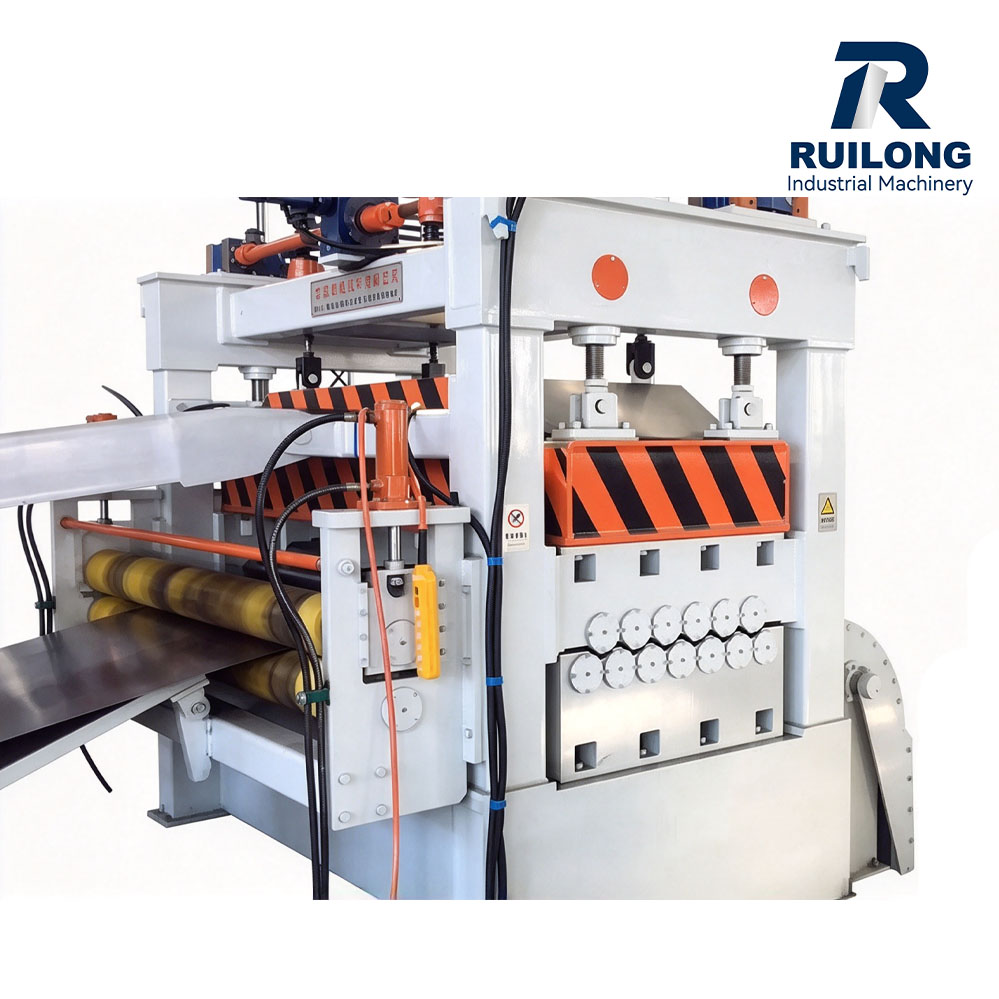
1. Clearance First — the Symmetric Burr Table
When both edges burr equally, the cut is centered and the clearance band is the whole story. Clearance is set as a percentage of gauge — too tight and the blades bruise and chip, too loose and the metal tears instead of shearing, leaving the roll-over and burr the customer measures. The working bands:
|
Material |
Clearance (% of gauge) |
Burr behavior when wrong |
|
Mild carbon (HR/CR) |
8–10% |
Tight: slivers and blade chipping; loose: heavy roll-over burr |
|
Stainless |
10–12% |
Work-hardens at the cut line — loose clearance burrs worse than on carbon |
|
High-strength |
10–13% |
Springback adds effective clearance; err on the tight side of the band |
|
Aluminum |
5–8% |
Galls to the blade; burr appears as smeared flashing |
Two stainless-specific notes belong on the setting sheet. First, the band is higher than carbon — the 10–12% range exists because austenitic grades work-harden at the shear line, and shear blade clearance setting for stainless steel that copies a carbon-steel setting tears rather than shears, exactly the mechanism the slitting-side stainless article documents for longitudinal cutting. Second, stainless forgives a dull blade worse than any other material: a blade that still cuts carbon cleanly will gall and drag on 304, so the blade polish and coating condition ride with the clearance setting, not after it. The acceptance number stays constant across all of this — burr under 10% of gauge, the same trigger the shear article uses for the regrind decision — because it is the number the customer measures.
✅ Bottom line: Symmetric burr is a clearance number — set it by material band, keep the blade edge polished, and measure against the 10%-of-gauge trigger.
2. Alignment Second — the One-Sided Burr Checklist
When burr concentrates on one edge, stop adjusting clearance — the strip is entering the shear off-square. The mechanism is geometric: entry guides hold the strip against a reference face before the cut, and any gap between strip edge and guide lets the strip angle into the blades, so one side cuts at the nominal clearance and the other cuts at several times it. The check sequence costs a shift, not a week: verify shear entry guide alignment causing uneven burr by measuring both edges on ten consecutive sheets — one-sided burr confirms geometry; then inspect the guide faces for wear (a bell-mouthed entry guides square at rest and angled at speed), check the guide-to-blade centering with the strip removed, and finally confirm the hold-down pads are landing flat, because a tilted hold-down reproduces the same one-sided signature. Run the checks in that order and the fault is found before the second blade adjustment is wasted on geometry.
The discipline that keeps this diagnostic honest is the burr log: burr height on both edges, sampled per shift, recorded against the coil and the blade hours. With the log, a slow-drifting one-sided signature is a guide-wear trend caught before the customer catches it, and a sudden symmetric jump is a blade-chip event caught before the next regrind — both readings Ruilong teaches crews to make during commissioning. Ruilong supplies the log format with the line and sets the review habit at commissioning, because burr control is a trend discipline — the clearance table above is the constant, the log is the variable, and the 10%-of-gauge trigger converts both into a scheduled regrind instead of an emergency one. The same symmetry logic applies downstream where slitting knives meet the strip, which is why the slitting burr article reaches the identical conclusion from the longitudinal side.
✅ Bottom line: One-sided burr is geometry, not clearance — run the both-edge test, inspect guides and hold-downs, and log burr per shift to catch drift early.
FAQ
Q: What clearance should I set for 2mm 304 stainless? A: 0.20–0.24mm, the 10–12% band — with a polished, ideally coated blade edge, because 304 work-hardens at the cut line and a dull blade galls before the clearance even matters.
Q: Why is burr height too high after shearing blade clearance was already reduced? A: Tighter clearance on a torn cut usually means the problem was never clearance — one-sided burr points at entry guide alignment, symmetric burr with tight clearance points at a chipped or galled edge, which is why the symmetry test comes before any table.
Q: How often should shear blade clearance setting for stainless steel be re-verified? A: Per blade regrind and per material-family changeover, plus the per-shift burr log as the continuous check — Ruilong prints the band table on the shear guard and ties the regrind trigger to the 10%-of-gauge log entry.
Put the Symmetry Test in Your Crew's Hands
Send Ruilong your material list and gauge range, and the engineering team will return the clearance band table, the guide-check sequence and the burr log format with the line offer from our China factory: as the manufacturer behind Tai'an Ruilong Machinery Co., Ltd., we quote supplier/OEM-direct with the settings sheet laminated for the shear guard, free of charge and without obligation. The custom bands are printed for your materials, not the catalogue's.