
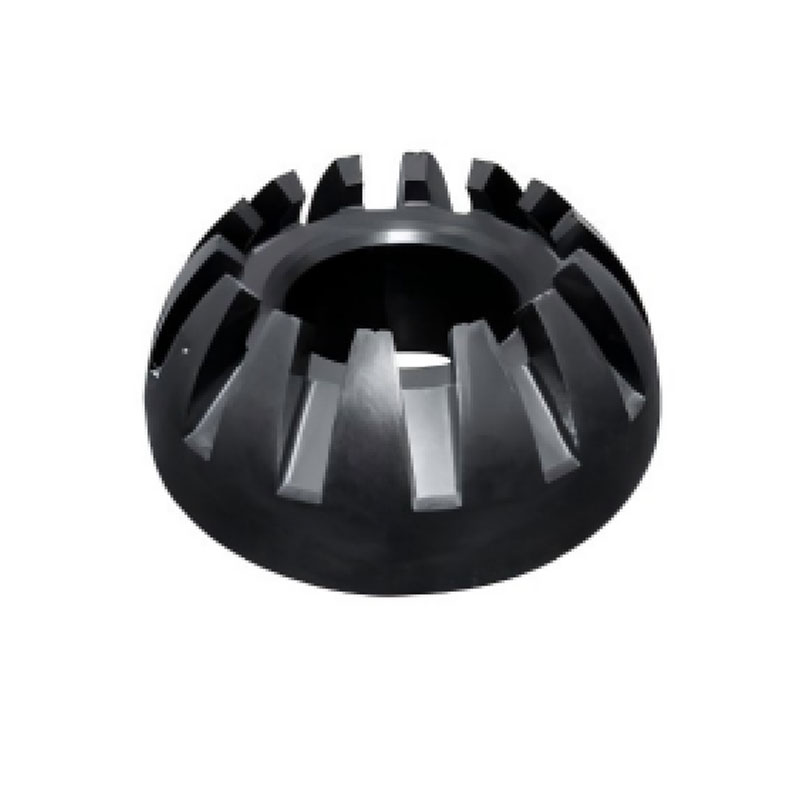
This guide explains what cold actually does to a seal, how to read the three competing temperature numbers, and which compounds still recover after a closure at -45 °C.
1. why BOP rubber becomes brittle in cold weather
Cold does not shatter a rubber seal first — it stops the rubber returning, and a sealing element that cannot return is already leaking even though it is visibly intact.
Three things happen as temperature falls
- Thermal contraction. Rubber contracts roughly ten times more than the steel housing. Contact pressure in the groove falls before any material changes state, so a seal that was tight at 20 °C can be loose at -20 °C on dimensions alone.
- Loss of segmental mobility. As the compound approaches its glass transition, the polymer chains stop uncoiling fast enough to follow the piston. The rubber behaves less like rubber and more like a stiff plastic.
- Crystallisation. NBR and natural rubber can crystallise when held cold for hours, not minutes. A rig that idles through a -35 °C night can find the element stiff in the morning even though nothing was chemically altered.
That sequence is why BOP rubber becomes brittle in cold weather in the field: contact pressure drops first, rebound slows second, and only then does the material crack under a closure. By the time cracking is visible, the well has already been unsealed for several operations.
Dynamic seals need more margin than static ones
An annular element is a dynamic seal. It must fold inward under piston pressure, then recover when pressure is released. A static gasket only has to stay where it is. This distinction decides which test number you use:
|
Indicator |
Test standard |
Question it answers |
Relevance to an annular element |
|
Brittleness temperature Tb |
ASTM D2137 |
At what temperature does it shatter on impact? |
Optimistic — "not broken" is not "sealing" |
|
Retraction TR10 |
ASTM D1329 / ISO 2921 |
At what temperature does it recover 10% of elasticity? |
The sealing-function limit |
|
Glass transition Tg |
DSC, ASTM D7426 |
Where does the polymer change state? |
Material parameter, not a service limit |
|
Torsional stiffness T2 |
ASTM D1053 (Gehman) |
Where does stiffness double? |
Useful for dynamic stiffness analysis |
Three numbers on three compounds can differ by 15–25 °C because they came from different tests. A datasheet temperature without a test method is not a specification; ask any supplier which standard produced it. CHENGSEN issues low-temperature figures as a pair — TR10 and brittleness — tied to the exact compound.
✅ Bottom line: TR10 is the number that predicts sealing. Brittleness only predicts whether the part breaks when dropped.
2. low temperature BOP packing element for arctic drilling conditions: choosing by TR10, not by label
The design rule is unglamorous but rarely applied: the compound's TR10 must sit at least 5–10 °C below the lowest expected temperature, and a reciprocating element needs the upper end of that margin.
A reliable low temperature BOP packing element for arctic drilling conditions starts with the ACN trade-off. More acrylonitrile means better oil resistance and worse low-temperature behaviour — the two move in opposite directions:
- 18–24% ACN — TR10 -40 to -30 °C, swell +25 to +45% in IRM 903; preferred for arctic, watch swell in aromatic mud
- 26–32% ACN — TR10 -30 to -20 °C, swell +12 to +25%; general duty, borderline below -25 °C
- 34–40% ACN — TR10 -20 to -10 °C, swell +5 to +12%; good oil resistance, unsuitable for winter
- 41–50% ACN — TR10 -10 to 0 °C, swell +1 to +5%; high-oil-resistance only, avoid cold climates
A competent manufacturer reaches roughly -49 °C TR10 with low-ACN NBR while staying far cheaper than FVMQ, which keeps it the arctic workhorse. HNBR is stronger and more sour-tolerant but typically lands at -35 to -25 °C TR10, with low-temperature grades near -42 °C. Standard FKM is a poor cold choice at -12 to -20 °C; only GL-type fluoroelastomers get close to -35 °C. Silicone (VMQ) and fluorosilicone (FVMQ) reach -55 to -70 °C, at a cost that usually reserves them for static or small-bore service.
packing element temperature rating chart for drilling BOP
Use this packing element temperature rating chart for drilling BOP as a screening table, then confirm with a compound report:
|
Compound |
Typical TR10 |
Sensible design minimum |
Oil resistance |
Relative cost |
|
Low-ACN NBR |
-49 to -40 °C |
-45 °C |
Moderate |
1× |
|
Standard NBR (28% ACN) |
-35 to -28 °C |
-25 °C |
Good |
1× |
|
Low-temperature HNBR |
-42 to -35 °C |
-35 °C |
Good |
2–3× |
|
GL-type FKM |
-35 to -25 °C |
-25 °C |
Excellent |
5–10× |
|
VMQ / FVMQ |
-70 to -55 °C |
-55 °C |
Poor / moderate |
6–12× |
Four field rules that matter more than the polymer
- State exposure temperature, not just working temperature. An element stored on a pipe deck sees the night minimum even when the rig floor is heated. Ask for the lowest exposure figure.
- Account for hardness shift. A compound measured at 75 Shore A at 23 °C can read above 90 Shore A at -40 °C. Specify hardness at the service temperature.
- Warm before installation. A frozen element forced over a mandrel can crack before it ever sees pressure. Controlled-temperature storage is part of the specification.
- Check the hydraulic side too. Cold hydraulic oil slows the closing time of the BOP regardless of the element. A -45 °C element cannot rescue a control system filled with summer oil.
CHENGSEN formulates low-ACN NBR in house and reports TR10 alongside compression set for each batch, because a winter element that meets hardness but misses retraction is a leak waiting for the first shut-in.
✅ Bottom line: Buy to TR10 with a 10 °C margin, and confirm the compound — not the polymer family — at your lowest exposure temperature.
FAQ
Q: Why does a rubber element rated -45 °C fail at -30 °C?
A: That rating was probably a brittleness temperature from ASTM D2137 — one reason why BOP rubber becomes brittle in cold weather gets misdiagnosed. Sealing depends on retraction; if TR10 is -30 °C, the element has under 10% elasticity at that point and will not follow the piston.
Q: Can I use the same winter element for sour service?
A: Not automatically. Low-ACN NBR improves cold behaviour but reduces oil resistance, and H₂S resistance follows a different qualification. State both H₂S partial pressure and minimum temperature on the enquiry — CHENGSEN treats them as two separate compound requirements.
Q: How do I read an ASTM D1329 report for a BOP seal?
A: Find TR10, not the headline minimum. Any packing element temperature rating chart for drilling BOP is a screening tool — the compound's TR10 should sit 5–10 °C below your lowest exposure temperature, and for dynamic service ask for compression set at that temperature too.
CTA: Send the temperature, get the TR10 report
Send lowest exposure temperature, closing-fluid temperature, mud system, bore and pressure rating to CHENGSEN. You receive the compound sheet with TR10, brittleness temperature, hardness at service temperature and compression set — the four numbers that decide whether an element seals in winter.
Zhejiang Chengsen Technology Co., Ltd. compounds low-temperature NBR and HNBR in house, moulds annular elements to API Spec 16A under an API Monogram licence, and runs ASTM D1329 retraction testing per batch. Custom compound development is available from single elements, with OEM-equivalent production and factory-direct pricing for fleet orders to Russia, Canada and the Nordic basins.
|
|
|
|
*Published: November 2026 |
By CHENGSEN Engineering Team* |