
|
|
|
|
*Published: November 2026 |
By RUNFENG Engineering Team* |
Tube material decides the sealing technology, and the sealing technology decides the machine configuration — not the other way around. You cannot hot-air seal bare aluminum, and you cannot mechanically crimp a plastic tube into a hermetic closure. The difference between aluminum tube crimping and plastic tube hot air sealing is not a preference on a quotation form; it is two different sealing stations, two sets of tooling and two very different changeover times. This guide maps tube construction to sealing method and then to the filler you should actually buy.
1. Four Tube Constructions, Two Sealing Physics
The inner layers determine whether heat can form the closure; the barrier layers determine what the product needs. Market estimates put PBL at roughly 42% of tube substrate, ABL at 28%, pure aluminum at 18% and mono-layer HDPE at 7% — so most toothpaste lines are sealing a laminate, not a simple plastic tube.
|
Tube type |
Construction |
Sealing method |
Typical window |
Main risk |
|
LDPE / PE mono-layer |
Extruded single plastic |
Internal hot air + cold jaws |
130–160°C, ~0.5–1.2 s dwell |
Scorching above ~165°C; weak barrier |
|
PBL |
Plastic multi-layer, EVOH/nylon barrier |
Internal hot air |
140–175°C, ~0.6–1.5 s |
Delamination if overheated; recyclable |
|
ABL |
Aluminium foil barrier between plastic layers |
Internal hot air, longer dwell |
150–185°C, ~0.8–2.0 s |
Foil adds thermal mass; incomplete seal if too short |
|
Pure aluminum |
Metal with internal lacquer |
Mechanical fold + crimp |
No heat |
Lacquer/formulation incompatibility |
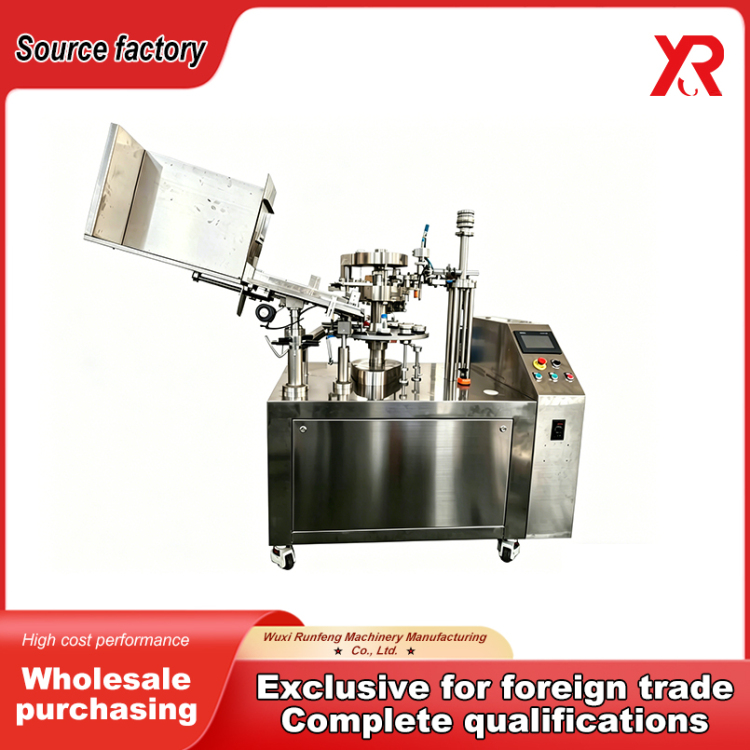
In hot-air sealing, a nozzle enters the open tail and blows a ring of superheated air outward, melting only the inner plastic wall while the decorated outer surface stays intact. Cold jaws then compress and cool the melt. In crimping, the metal tail is folded flat and compressed by a wheel or jaws in a double, triple or saddle fold — a purely cold, mechanical operation. Fold depth, not fusion, provides the barrier.
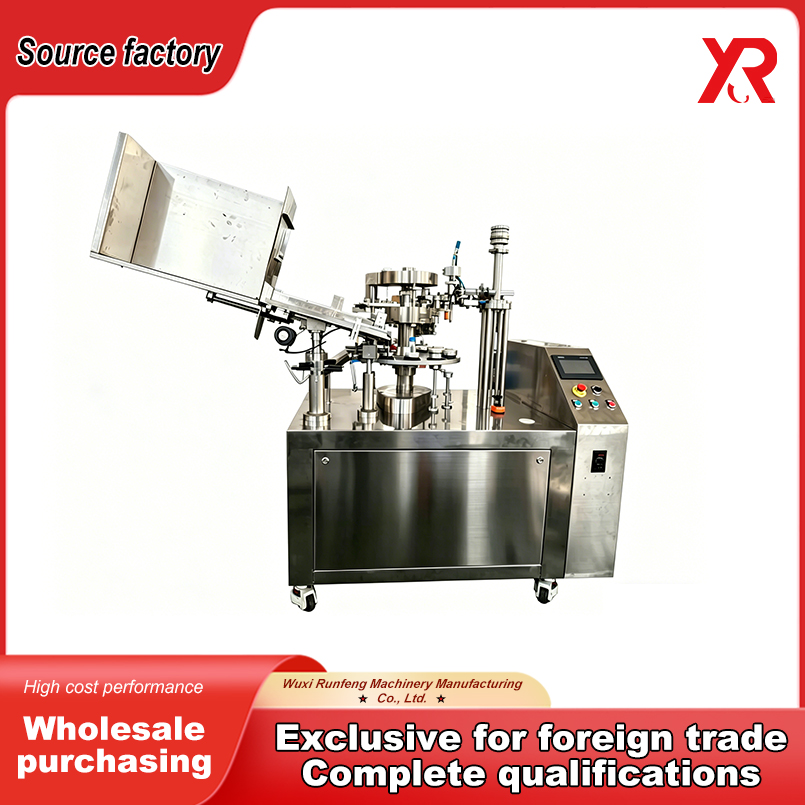
The practical takeaway: a RUNFENG hot-air head in a laminated tube filling machine ABL PBL toothpaste packaging setup can cover both laminate types with temperature and dwell recipe changes, but pure aluminum needs a different sealing station altogether. Treat ranges as starting points only — wall thickness, resin grade and supplier lot all shift the real window, which must be confirmed by a seal-window trial.
✅ Bottom line: Heat seals plastic and laminate; folding closes metal. The tube specification comes before the machine specification.
2. What Actually Differs at the Sealing Station
The temperature displayed on the HMI is not the temperature at the jaw. It is the reading from a thermocouple embedded in the heater, which can differ from the real jaw surface by 2–8°C as it drifts or accumulates residue. If the deviation exceeds ±3°C, recalibrate the probe before changing any process parameter — adjusting setpoints to compensate for a drifted sensor creates a documentation problem, not a better seal. RUNFENG machines use PID control that should hold within about ±2°C; wider oscillation usually means the loop needs retuning.
For hot-air stations, four variables interact: air temperature, airflow stability, clamping pressure and cooling-jaw timing. Too much heat scorches or delaminates; too little leaves an unfused inner layer that looks sealed but leaks under product pressure. Pressure and dwell partially compensate for each other, which is why seal strength should be validated by peel testing (ASTM F88) rather than visual inspection. Vacuum decay testing (ASTM F2338) gives a non-destructive integrity check for pharmaceutical work.
Crimping has its own failure modes. Fold too loosely and micro-leaks develop; crimp too tightly and the jaws cut the metal. The internal lacquer matters just as much — an epoxy-phenolic or polyamide coating that is incompatible with your formulation's pH or solvent content can corrode within three to six months, creating a contamination and recall risk. Validate the lacquer against the paste before committing to volume, not after the first stability study fails.
This is the heart of the difference between aluminum tube crimping and plastic tube hot air sealing: one station is a thermal process with temperature control and cooling, the other is a forming process with tooling and pressure. Switching between them typically takes 60–90 minutes because the sealing head, mandrel sets and sometimes the nozzle configuration all change — versus 20–30 minutes for a same-material diameter change.
✅ Bottom line: Validate the jaw, not the display; validate the lacquer, not just the fold. Both sealing families need measurement-based acceptance.
3. Choosing Material and Machine Together
Buyers asking which tube material is best for toothpaste packaging machine compatibility are starting from the wrong end. Start with the formulation. Abrasive silica pastes need a robust pump but work well with laminate tubes. Oxygen-sensitive actives — peroxides, vitamin C, retinol — push you toward ABL or pure aluminum for barrier and light protection. Pharmaceutical ointments and eye gels traditionally use pure aluminum with a validated internal lacquer. Ordinary moisturisers and cleansers can use PBL or mono-layer PE, where fast changeover and recyclability matter more than maximum barrier.
|
Formulation need |
Preferred tube |
Sealing |
Machine configuration |
|
Silica abrasive toothpaste |
ABL or PBL laminate |
Hot air |
Hardened pump parts, stable dual-zone heat, cold jaws |
|
Whitening / peroxide actives |
ABL or pure aluminum |
Hot air or crimp |
High barrier, light protection, lacquer validation |
|
Essential-oil or fragrance sensitive |
ABL |
Hot air |
Barrier layer, controlled residual oxygen |
|
Ointment / ophthalmic |
Pure aluminum |
Mechanical crimp |
Fold tooling, tail coating, coating inspection |
|
Standard cream / cleanser |
PBL or PE |
Hot air |
Fast-changeover hot-air head, recipe memory |
Now the commercial question: one machine or two? A common rule of thumb is that if your split is around 85% plastic and 15% aluminum, two dedicated machines give better total cost than a hybrid. A convertible "combo" machine starts to make sense near a 40/60 split, or when a contract manufacturer needs the flexibility to accept both types of customer job. Do not pay for a convertible sealing station you will use twice a year.
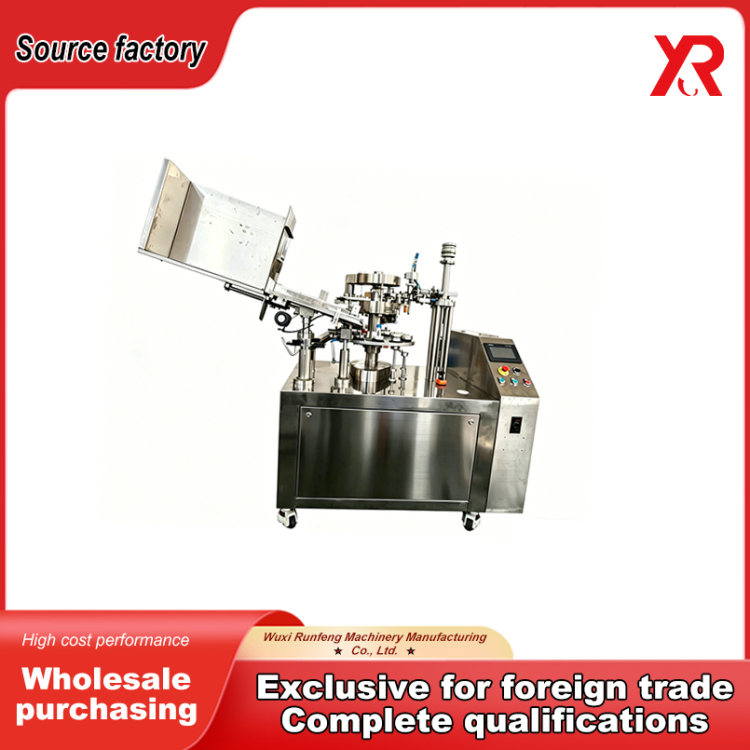
RUNFENG supplies GF-series fillers with hot-air sealing for plastic and laminate tubes, mechanical fold-and-crimp options for aluminum, and tooling across the common diameter bands. Beyond the filler, the company also builds aluminum-tube line equipment — end-coating machines, can printing and curing systems — which matters when your product decision moves from the tube to an entire metal-tube line. Wuxi Runfeng Machinery Manufacturing Co., Ltd. supports OEM and ODM configuration, seal-station selection, tube tooling and remote commissioning from a single unit upward.
✅ Bottom line: Formula first, tube second, sealing station third. A hybrid machine is a volume decision, not a technical one.
FAQ
Q: What is the difference between aluminum tube crimping and plastic tube hot air sealing?
A: Crimping is a cold mechanical fold of a metal tail, using double, triple or saddle folds; hot-air sealing melts the inner plastic layer of a plastic or laminate tube and fuses it under cold jaws. The two need different sealing heads and different tooling, with 60–90 minutes typically needed to convert a hybrid machine.
Q: Can ABL and PBL tubes run on the same machine?
A: Yes. Both are heat-sealed laminates, so a single hot-air station with saved temperature, airflow and dwell recipes normally covers them. ABL's foil layer adds thermal mass and usually needs a longer dwell; confirm the real window with seal trials for each tube supplier and lot.
Q: Which tube material should I choose for my packaging line?
A: For most toothpaste, ABL or PBL laminate with hot-air sealing is the practical answer to which tube material is best for toothpaste packaging machine compatibility — it balances barrier, print quality and sealing speed. Reserve pure aluminum for high-barrier pharmaceutical or premium products where mechanical crimping and a validated lacquer are worth the extra changeover time.
CTA: Send Us Your Tube Sample, Not Just a Specification
A laminated tube filling machine ABL PBL toothpaste packaging configuration cannot be finalised from a datasheet. Send the RUNFENG engineering team your tube sample, paste viscosity, target output and seal-strength requirement. Within 48 hours you will receive a sealing-station recommendation, a tooling list, a FAT acceptance method and a quotation that separates the hot-air and crimp configurations — so your packaging decision and your equipment decision are made against the same tube.