
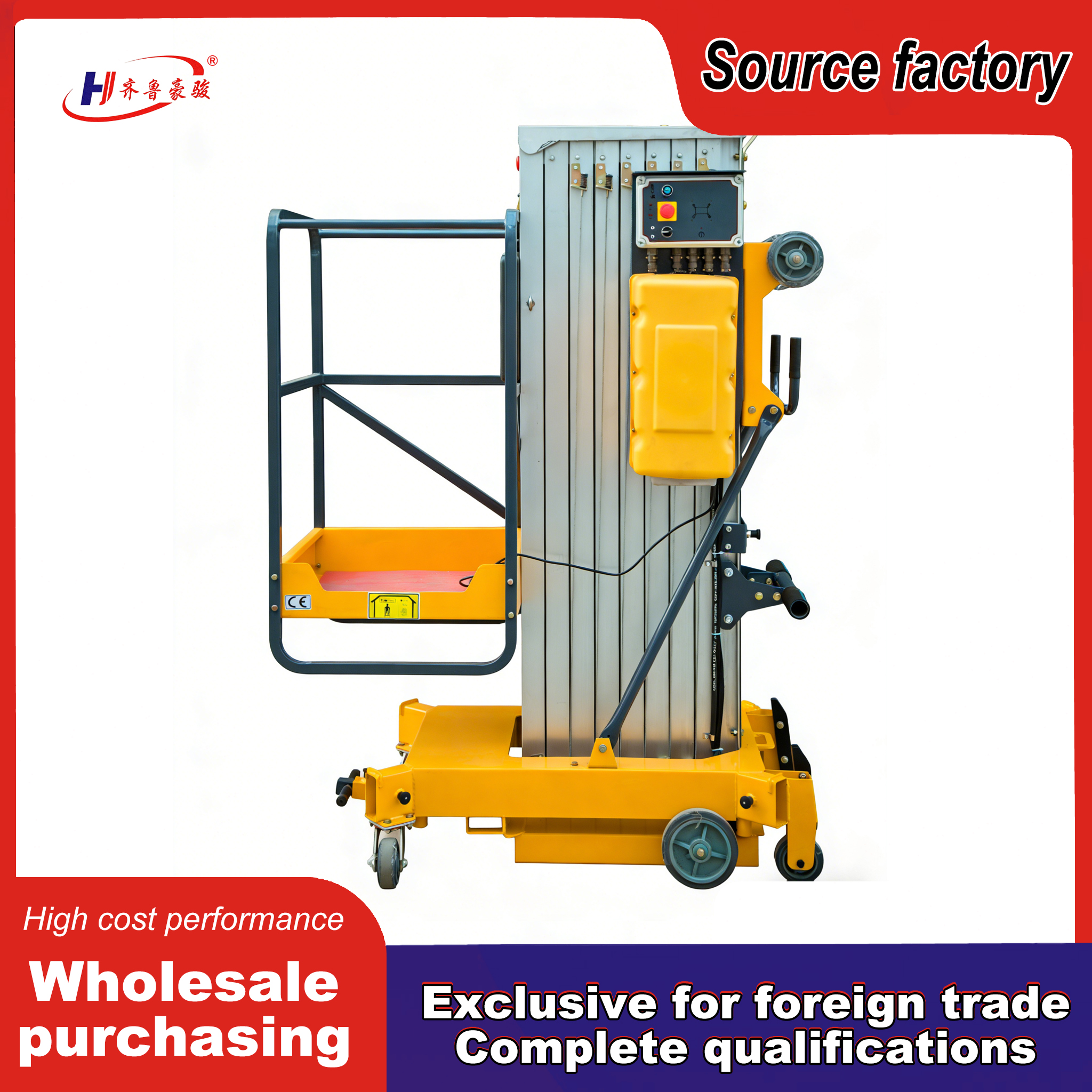
The distinction below is the one that aluminum mast lift vs vertical platform lift which code applies questions usually miss: the test is not what the machine looks like, but whether it is fixed to the building and who is standing on it.
1. How do you tell which code applies?
Three questions settle it: is it bolted to the building, is the occupant a worker or a passenger, and does it travel more than one floor? Any single "yes" on the first two sends you to the lift standards.
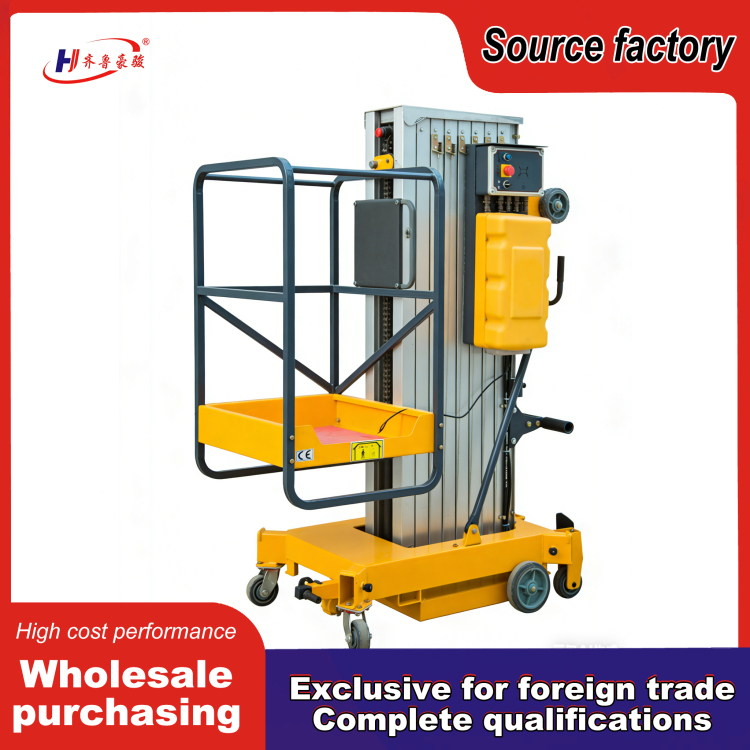
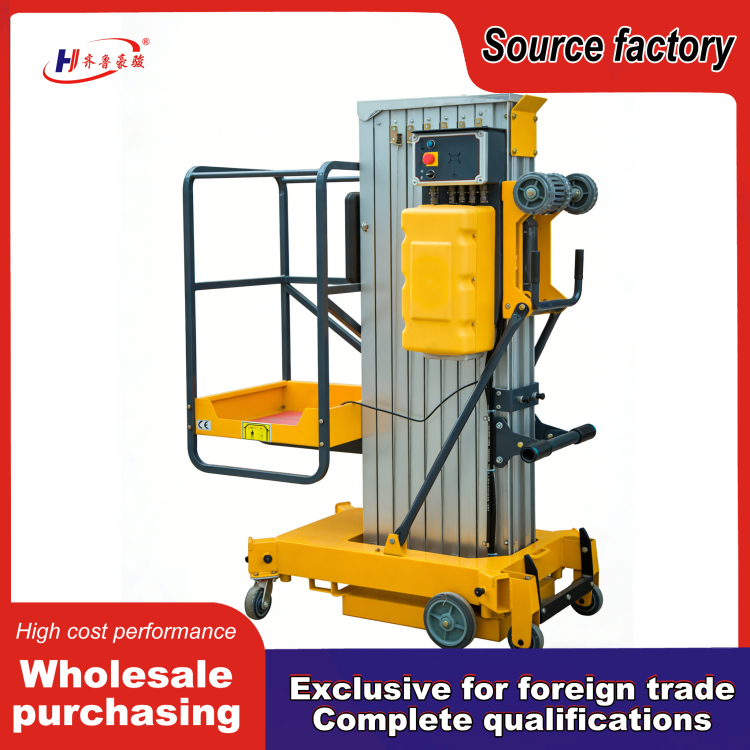
- Fixed to the structure? A vertical platform lift is anchored to a liftway with guide rails, landing gates and a fixed control station. A mast lift has wheels, a stowed height and a tie-down point — it is designed to be moved between jobs.
- Worker or passenger? A MEWP carries a worker who is performing a task at height. A platform lift carries a person who is the cargo, under continuous pressure control, usually in a wheelchair.
- More than one floor? ASME A18.1 explicitly limits the device to a single floor of penetration. A three-stop unit is an elevator under ASME A17.1, not a platform lift — a distinction that catches out buyers who order "a small lift for three levels."
Get any one of those three wrong and the aluminum mast lift vs vertical platform lift which code applies question returns as a rejected acceptance inspection, usually after the crate has been opened and the concrete cut.
|
|
Aluminum mast lift (MEWP) |
Vertical platform lift |
|
US design standard |
ANSI A92.20 |
ASME A18.1 |
|
EU design standard |
EN 280 |
EN 81-41 |
|
Fixed to building |
No — mobile equipment |
Yes — anchored liftway |
|
Floors served |
Any height, repositioned at will |
One floor maximum under A18.1 |
|
Maximum speed |
0.077–0.30 m/s typical |
0.15 m/s under EN 81-41 |
|
Platform area |
0.59–1.20 m² |
1.67 m² (18 sq ft) maximum under A18.1 |
|
Installation |
Delivered and commissioned |
Permit, often a licensed lift contractor |
|
Ongoing inspection |
Employer's inspection regime, annual thorough exam |
Jurisdictional lift inspection |
The commercial consequence sits in the last two rows. A mast lift arrives on a truck and starts work; nobody applies for a building permit, and no elevator inspector signs it off. A vertical platform lift usually requires a permit, an installer licensed for lift work, and an acceptance inspection by the state or municipal lift authority — plus periodic inspections afterwards. HAOJUN quotes both categories and routinely tells buyers which one their project actually needs, because shipping the wrong one means the equipment sits in a crate while the permit is refused.
✅ Bottom line: Bolted to the building means lift code; on wheels means MEWP code — and the permit follows the category, not the price.
2. What does each standard actually require?
A92.20 governs the machine; A18.1 and EN 81-41 govern a building element — and the design checkpoints barely overlap. For buyers reviewing ansi a92.20 design requirements for vertical mast lifts, the practical list is short and testable.
Under A92.20 a mast lift must have a 1.10 m top guardrail with a mid-rail and toe board, a self-closing gate with a positive latch, an outrigger or stabiliser interlock that prevents elevation unless every pin and sensor is satisfied, a tilt cut-out calibrated by the manufacturer, and a rated capacity calculated at 90.7 kg per person plus tools. A92.22 then covers use: familiarisation of each operator, a pre-use inspection, and an annual inspection by a qualified person. None of that involves a building permit.
Most of the ansi a92.20 design requirements for vertical mast lifts that fail at audit are the interlock clauses, not the structural ones — outrigger pins, gate switches and tilt cut-outs, because those are the parts an operator can defeat with a cable tie.
Under A18.1 the checkpoints are structural and architectural instead: 80-inch minimum headroom, gates that are power-operated and stay open at least 20 seconds, continuous-pressure operation, a platform that cannot exceed 18 sq ft, and — under the ADA Standards, which reference the 1999 or 2003 editions — no attendant operation and no portable units. A device that needs an attendant to hold a button does not satisfy the ADA even when it satisfies A18.1.
|
Checkpoint |
A92.20 mast lift |
A18.1 / EN 81-41 platform lift |
|
Guardrail |
1.10 m top rail, mid-rail, toe board |
Enclosure or walls, edge protection |
|
Entry |
Self-closing gate, positive latch |
Power-operated gate, open ≥20 s |
|
Control |
Platform-mounted, operator in basket |
Continuous pressure, often attendant |
|
Stability |
Outrigger interlock, tilt cut-out |
Guide rails fixed to structure |
|
Capacity basis |
90.7 kg per person plus tools |
Rated load, wheelchair plus passenger |
|
Travel limit |
None — height of the mast |
One floor (A18.1); 0.15 m/s (EN 81-41) |
The inspection interval follows the same split. The loler inspection interval for mast lifts used to lift people is six months in the UK — regulation 9 of LOLER requires a thorough examination at least every six months for equipment used for lifting people, regardless of whether the machine is a MEWP or a lift. What changes is who performs it: a competent person under LOLER, against an annual inspection by a qualified person under A92.22 in the US, and a jurisdictional lift inspector for an A18.1 device.
One timing note for 2026 orders. The EU Machinery Directive gives way to the Machinery Regulation (EU) 2023/1230 from 20 January 2027. Both categories sit inside that machinery framework rather than the Lifts Directive — mast lifts declared via EN 280, accessibility platforms via EN 81-41 — so both technical files need re-issuing against the new regulation. Buying for a five-year fleet life, ask which instrument the current declaration of conformity cites, and whether the supplier intends to re-issue it.
✅ Bottom line: Six-monthly examination under LOLER applies either way, but only the platform lift also needs a permit and a lift inspector.
FAQ
Q: Can a mast lift be used as an accessibility lift for a wheelchair user?
A: It can physically lift one, but it cannot serve as an accessible route. The ADA Standards require ASME A18.1 equipment for that purpose, which is why the aluminum mast lift vs vertical platform lift which code applies question matters commercially — a MEWP in a lift shaft fails inspection regardless of its capacity.
Q: Does a mast lift need a building permit, and how often is it examined?
A: Normally no permit, because it is equipment rather than a fixed installation. The loler inspection interval for mast lifts used to lift people is six months in the UK, and an annual inspection by a qualified person applies under A92.22 in the US. A vertical platform lift usually needs a permit, issued against ASME A18.1 or EN 81-41 with a licensed installer named on it.
Q: Can one factory supply both categories?
A: Yes, and HAOJUN does — mast lifts to A92.20 and EN 280 from the MEWP line, and accessibility platforms built to order. They are separate OEM programmes with separate technical files, so custom projects need the destination market stated at enquiry, not after production. Jinan Haojun Lifting Machinery Co., Ltd. will confirm the applicable standard in writing with every quotation.
CTA: Tell us the destination and the duty, not just the height
Send the country, the intended occupant and whether the unit will be fixed to the structure. HAOJUN will confirm in writing which standard applies, which declaration of conformity the machine ships with, and whether the project needs a permit before the crate arrives.
HAOJUN supplies MEWP mast lifts and accessibility platforms from one factory, with wholesale pricing for distributors and full technical files for customs and inspection. Contact Jinan Haojun Lifting Machinery Co., Ltd. for a compliance summary within two working days.
|
|
|
|
*Published: November 2026 |
By HAOJUN Engineering Team* |