
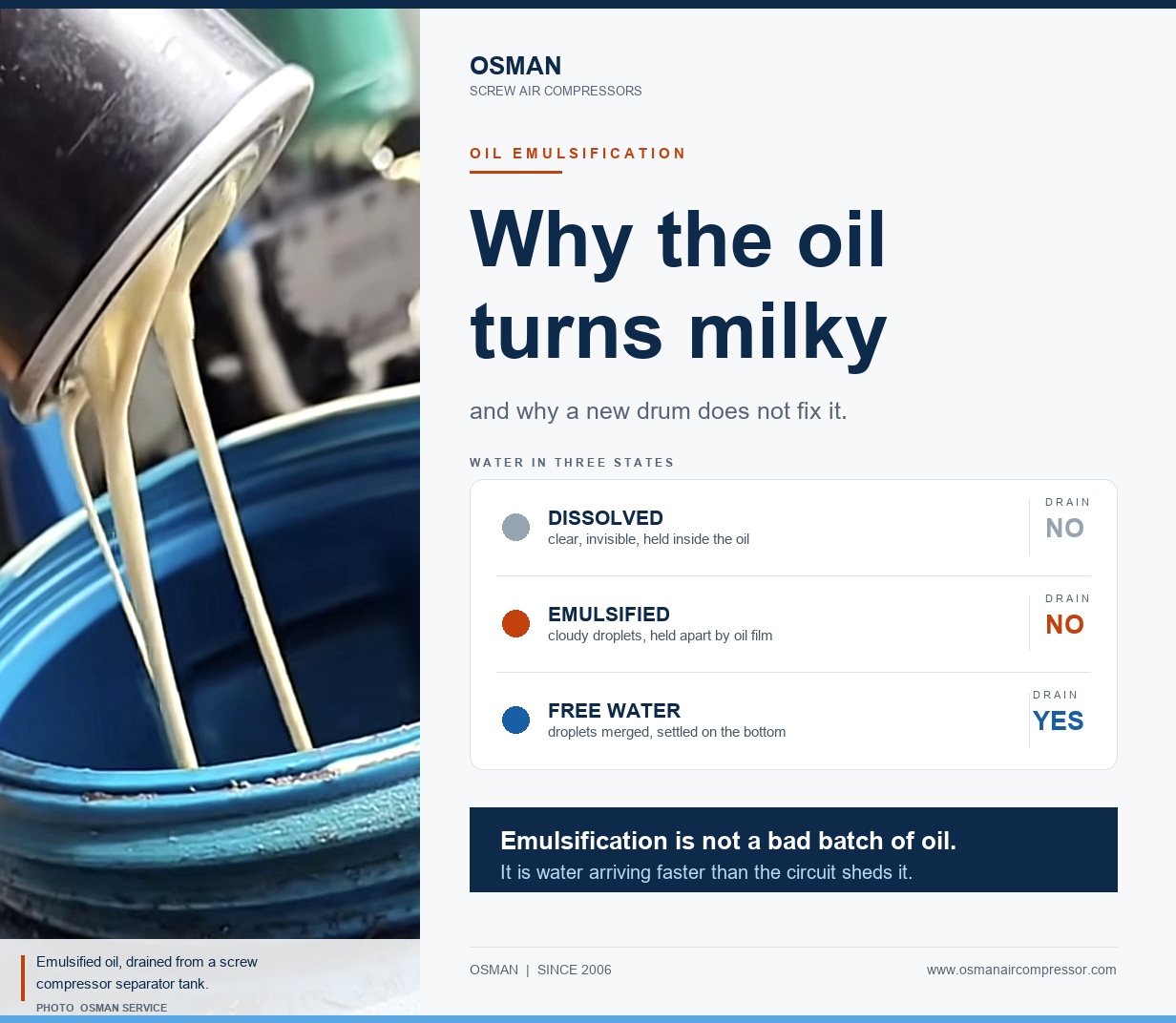
A white sight glass is not the diagnosis
The call usually arrives after the second oil change. Someone saw something the colour of milk in the sight glass and ordered a drum. Two weeks later it was white again.
The oil is rarely the fault. A compressor that turns its lubricant milky is holding water, and it holds water because more is arriving than leaving. A new drum empties the account without touching either side of it.
Every service manual lists where water comes from. The useful question is why this machine cannot get rid of it. Another unit in the same building, on the same shift, breathing the same air, stays clear.
Emulsification is a balance, not a defect
Oil is injected into the air end and meets the incoming air directly. Air always carries water vapour, so water reaching the oil circuit is normal. What separates a healthy machine from an emulsified one is the outlet side. Water leaves by three routes.
Evaporation is often the main route under normal conditions. Once the oil is hot enough, water returns to vapour and leaves with the compressed air. It condenses downstream, usually in the aftercooler, receiver or dryer, and goes out through a condensate drain.
Separation is the second. A compressor lubricant is formulated to shed water. Droplets merge, grow heavy, sink and collect at the bottom of the tank, where a drain reaches.
Replacement is the third, since water leaves with the oil at the change.
Emulsification begins when inflow outruns those routes and stays ahead of them. Diagnosis should aim at whichever route narrowed. A humid site and a cool one both have a large inflow, and need different work.
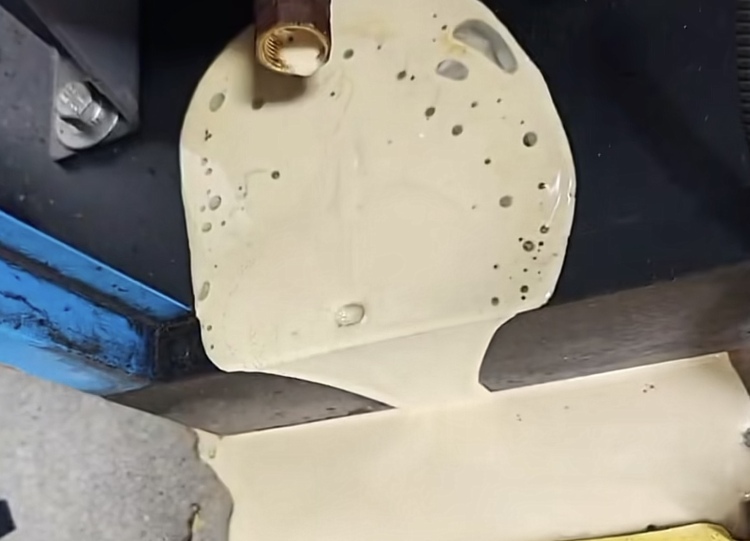
Water sits in the oil in three forms
Water in compressor oil takes three forms. Only one settles within reach of a drain.
Dissolved water sits in the oil at molecular level and leaves it clear. That is not a clean bill of health, because the water is still there and can climb past what the oil tolerates.
Emulsified water is dispersed as tiny droplets, each coated in a film of oil. The mixture turns cloudy, then milky white. It neither sinks nor evaporates quickly, because the droplets are small and the film holds them apart.
Free water is what the oil has rejected. Droplets have merged into a layer at the bottom of the tank, and the drain removes it. Until that drain runs, the layer stays.
Emulsion is the state that gets noticed. Persistent water contamination can weaken the lubricating film, accelerate corrosion and increase wear in bearings and the air end. Dissolved water needs watching, free water needs a drain that runs, and emulsion that keeps returning points at oil and machine.
Where the water gets in
Five routes cover the usual cases, at different speeds.
Intake air is the continuous one. Warm air holds more vapour per cubic metre, and a humid season loads the drying chain. Most leaves with the compressed air. What reaches the oil depends on oil temperature, not weather alone.
Standing idle is the quiet one. During shutdown the tank and its contents cool. Depending on the intake and pressure relief arrangement, moist air may enter, and vapour inside condenses on colder surfaces. A machine that runs one shift and stands for two collects water every night without a leak.
Cooling water leakage is the fast one, on water cooled units. In some designs the cooling circuit runs above oil pressure, so a tube or gasket failure pushes water straight in. The level climbs with no top-up and the colour goes white within hours.
Backflow from the discharge side gets overlooked. Condensate gathers at low points in the discharge pipe, receiver and dryer. A check valve that does not seat gives it a way back, though it still needs a route to the tank, so the layout decides how far it gets.
Maintenance is the ordinary one: an open drum in a damp corner, a wet funnel, a wash-down not dried before the covers went back on.
Why an oil that used to shed water stops doing it
Compressor oil demulsibility degrades with age. An oil that shed water when new can lose that ability long before its hour limit, while the dipstick looks normal.
Compressor oil oxidation starts the decline. Heat and oxygen make polar molecules, organic acids among them, and these behave like emulsifiers. A rising acid number points the same way, though it does not measure how well a fluid sheds water.
Mixing oils is underestimated. Two lubricants with different base oils or additives can each be sound and still behave unpredictably once blended. Topping up with whatever drum is on the shelf is easy, and the cost arrives months later. What a compressor lubricant does besides lubricate covers the rest.
Cleaning residue catches people after a repair. Work on turbine oils found that alkyl benzene sulfonate left on metal after a flush can destroy water separation at concentrations too low for routine oil analysis to see. Read it as a sign of how little it takes, not as compressor data.
Base oil chemistry is a choice, not a defect. Some polyglycol formulations hold water far more readily than conventional synthetic hydrocarbons. That asks for different monitoring and maintenance, not a verdict on quality.
The low temperature that has nothing to do with the set point
The compressor heats its own oil. Compression does the heating, so oil temperature follows how hard the machine works, not the number on the display.
Load ratio comes first. When demand sits far below rated output, the machine spends much of its time unloaded and generates little heat. Depending on the control system and how it is cooled, oil temperature can settle below the level where water leaves as vapour. No alarm appears, and water accumulates. This cause is easy to miss.
Short runs are worse. A machine that starts and stops, or runs minutes at a time, never reaches working temperature.
The thermostatic valve fails two ways. Stuck on the cooler side, it cools continuously and the oil never warms up. Stuck the other way, oil bypasses the cooler and runs hot. High discharge temperature has its own causes and checks.
Cold ambient with strong ventilation does the same, pulling heat out faster than a light load replaces it.
There is no universal working temperature to quote. The correct range depends on the model, the pressure and the maker's setting. Evaporation is not a fixed threshold either. The rate depends on how much is dissolved, on oil temperature, on pressure and on how well oil and air mix. What matters is whether conditions let moisture leave the oil circuit faster than it enters.
What the colour does not tell you
Air compressor oil turning milky has several owners. Entrained air clouds oil the way water does, but bubbles rise. A sample left standing clears from the top down. Foam gathers at the surface while the oil below may be clean. Sometimes the oil is fine and the glass is not, because water sits on it.
Draw a sample from the bottom of the tank into a clear bottle and leave it a day. Read it as a field check, not a verdict, because emulsion separates slowly and bubbles look like cloud. A layer at the bottom means free water and a drain that is not working. Uniform cloud points to emulsion. A sample that clears was aerated.
Water content needs a laboratory. Karl Fischer titration to ASTM D6304 reports parts per million, and comparing months turns a reading into a trend.
Demulsibility is measured by a water separability test, ISO 6614 or D1401. Forty millilitres of oil and forty of water are stirred for five minutes. The usual temperature is 54 degrees Celsius, or 82 for oils above 90 centistokes. The cylinder then stands, with readings every five minutes. Three millilitres of emulsion or less after thirty minutes is a common expectation, not a pass mark built into the method. Acceptance limits belong to the lubricant specification.
A drop of oil on a hot steel plate is the field version, and it only screens. A crackle says water is present, not how much. Keep the drop small and stand back, since hot oil spits.
Fix the source, then the oil
The order of work matters more than any single test. An oil change done first hides the evidence.
Start at the drain. Empty the tank daily for a week and measure what comes out. A cup a day and a litre a day are different problems.
Then read the history: loaded hours against total, oil temperature, ambient. Next, the valves. The automatic drain comes first, the most likely to be blocked and the least likely to be noticed. After that, the minimum pressure valve and the discharge check valve. On water cooled units, stop the machine and watch the level. A level that climbs while it is off is water from the cooling circuit.
Oil that is slightly hazy with a low water result often recovers once the machine is back in its working range, rechecked in two weeks. Oil that stays milky, or whose water result sits above the lubricant maker's limit, generally needs replacing. The oil filter is normally replaced too, as the compressor maker advises. The separator element is separate. Use the checks for changing it to decide, since an element that has seen emulsion may not come out working as before.
Some cases are a sizing problem wearing a maintenance costume. A compressor selected for a peak that never arrives runs lightly its whole life. The load ratio stays low, the oil stays cool, and every oil change buys a few weeks. Compare loaded with total hours over a month.
Receiver volume is often the cheapest correction, though not reliable on its own. A larger receiver lets the machine run loaded for longer stretches and idle for longer between them. Whether that helps depends on the demand profile and the control strategy, so size it from measured consumption rather than assumed demand. Sometimes the machine is the wrong size, and that is worth saying.
The flush that shortens the life of the next fill
When the oil comes out white, cleaning everything before the new charge goes in is the right instinct. The method usually chosen is not.
A general purpose flushing agent circulated and then drained leaves surfactant behind. Surfactant is what makes an emulsion stable, and a small amount sits in pipework, cooler and sump that draining cannot reach. The fresh oil starts service with less water separation than the drum was formulated to have. The machine emulsifies again sooner, the workshop blames the oil, and the cycle repeats with another brand. Some detergent based cleaners may also affect lubricant compatibility and water separation, depending on formulation.
Where a flush is needed, the fluid and the procedure decide the outcome. Follow the procedure issued by the lubricant supplier or the compressor maker, with the fluid it names, draining warm where it says. Do not improvise with whatever cleaner is on the shelf. The first charge may still be sacrificial, and one drum is cheaper than the next twelve months.
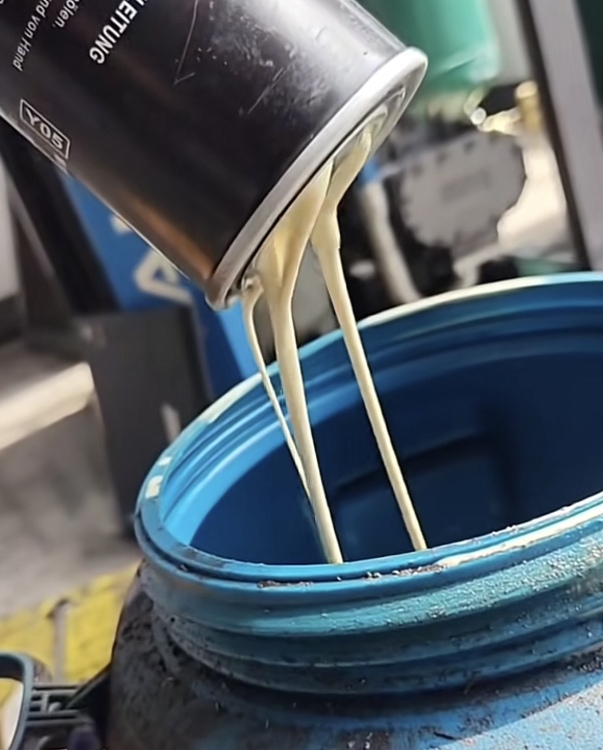
What we supply, and what we need from you
We build screw compressors from 5.5 kW to 250 kW, and supply separator elements, oil filters and lubricant.
If your oil has gone milky, send four things and we can usually narrow the cause remotely. The water result in parts per million if you have one. The load ratio from the controller. The oil temperature the machine normally runs at. And the colour of the sample after it stood for a day.
None of this replaces routine screw compressor oil maintenance. It only says where to point it. The oil in the sight glass is the end of a process, not the beginning of one.