
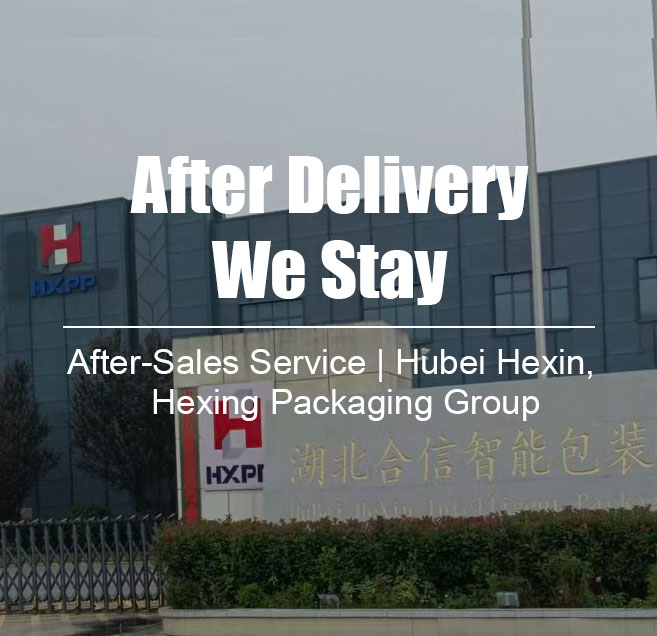
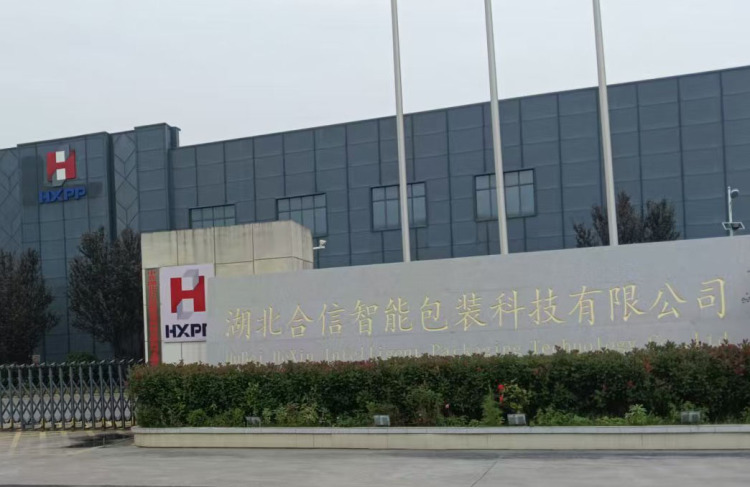
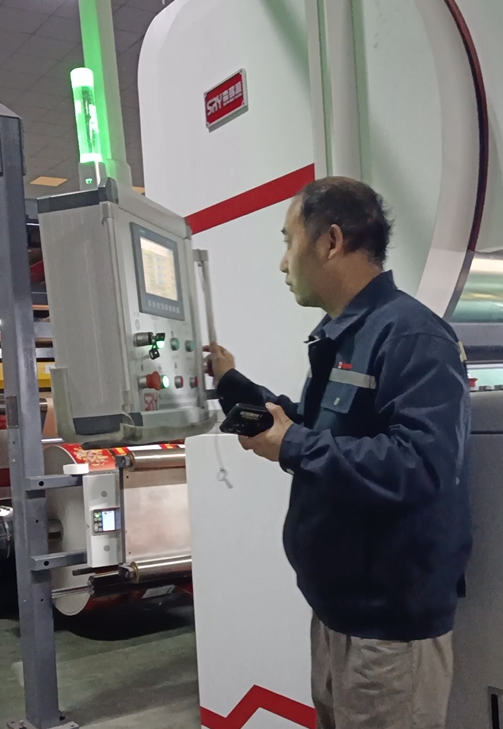
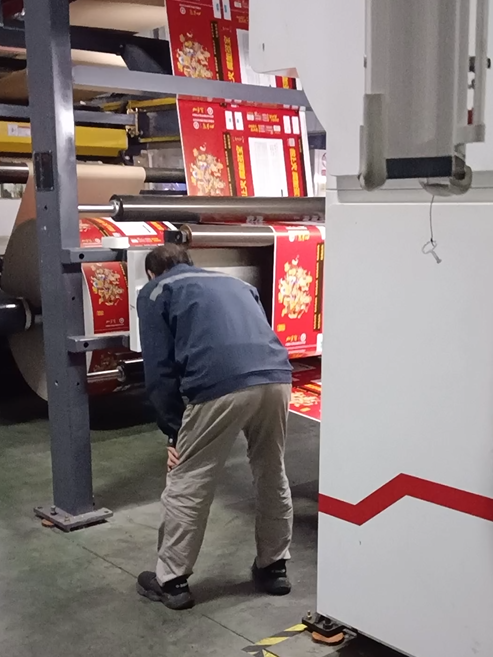
Selling a machine is only the beginning. On 9 November 2026, the Senruiyuan after-sales team visited Hubei Hexin Intelligent Packaging, a plant of China Hexing Packaging Group, for a full inspection and preventive maintenance service on an automatic water-based dry roll-to-roll laminating machine. The team reviewed line parameters, checked fasteners, transmission parts and electrical components, ran a trial with material, and briefed the operators on site. A written inspection record and a set of follow-up recommendations closed the visit.
What a full service visit covers
The aim was to bring the machine back to its commissioned condition and find problems before they cause unplanned stops. Five areas were covered:
- Line running parameters. Speed, unwind and rewind tension, coat weight, drying temperature and lamination pressure were compared with the process card; deviations were recorded and corrected on site.
- Mechanical condition and fasteners. Frame, rollers, bearing blocks and bolts were checked for looseness, wear, noise and tracking problems, then re-tightened or replaced where needed.
- Electrical and control systems. Sensors, emergency stops, safety circuits, drive status and alarm history were reviewed to rule out hidden faults.
- Cleaning and lubrication. Adhesive residue and dust were removed, lubrication topped up, and the remaining life of wear parts assessed.
- Trial run and handover. The line ran empty and then with material. Operators were told what was found, what was done, when the next service was due and which spares to stock.
Parameters and fasteners drew the most attention: the first keeps bond quality stable, the second protects mechanical accuracy over long runs. If you are choosing a process rather than maintaining one, our guide to water-based, thermal and solvent-free lamination sets out where the differences begin.
Why large packaging groups look past the nameplate
Hubei Hexin Intelligent Packaging is part of China Hexing Packaging Group, one of China's largest packaging groups, with more than 60 subsidiaries. Senruiyuan works mainly with large packaging printing groups in China, including many of the country's leading converters.
For a plant in continuous production, an unplanned stop, a process reset after a job change, or a wear part that takes a week to arrive all land in the cost of that batch. Group customers run equipment at several sites to one standard, so they expect fast response, available spare parts and usable maintenance records. The questions asked after acceptance are rarely about nameplate speed: they are about how quickly the line can be recovered and what to do each day to keep it running. An energy cost and payback worksheet puts a number on running cost, and a nameplate speed versus real output calculation shows why a headline speed is not a production promise.
Turning service into a checkable record
This visit closed with a written inspection record: the measured value of each parameter, the problems found, the action taken, the recommendation and the date of the next service. A copy goes into the company service file, so spare parts can be prepared in advance and later faults traced back to a documented baseline.
| Record field | What to write down | Why it matters later |
|---|---|---|
| Parameter reading | Measured and set value, deviation, substrate and speed at the time | Makes future drift visible instead of guessing |
| Finding | Part, location, symptom and severity | Lets the next engineer pick up where this visit stopped |
| Action taken | Adjusted, re-tightened, cleaned, lubricated or replaced | Separates a fixed issue from an open one |
| Recommendation | Spare parts, next service date, operator check to add to the daily routine | Turns the visit into a plan rather than a report |
Keep the same measurement points and substrate reference from one visit to the next, or the numbers cannot be compared. The format matters less than the habit of writing it down.
A maintenance checklist to ask any supplier for
Whichever machine you buy, put these points into the service agreement before the order is signed:
- Which parameters are checked, at what speed and on which substrate, and who signs off the readings.
- Which fasteners, rollers, bearings and wear parts are inspected, and the replacement thresholds.
- The response time for a fault that stops production, and how spare parts are stocked and shipped.
- Whether a written inspection record is issued after every visit and kept in a shared service file.
- Whether operators are trained to run the daily checks, and how the next service date is agreed.
Two related guides go deeper: a lamination defect troubleshooting guide for bubbles, wrinkles and delamination, and a note on short runs and frequent changeovers, where process reset time becomes a maintenance issue as much as a scheduling one.
Where preventive maintenance meets the rest of your line
A laminator does not run on its own. Unwind and rewind tension, the drying section, the splicer and the upstream press all set the conditions it has to hold, so a service visit is a good moment to check whether stored recipes still match the job mix, whether splice timing still suits the real line speed, and whether drying capacity still supports the speed being asked for. Our checklist for roll-to-roll laminating machines covers the machine side. Note the substrate and speed with every reading: a tension value that is correct for one film structure can cause a defect on another.
Plant visits and technical exchange
Printing and packaging companies evaluating similar equipment can arrange case discussions and, subject to the customer's consent, a visit to a working installation. Visits to our Foshan factory can also be arranged to watch assembly, commissioning and a material trial on the same type of line. Tell us the substrate structure and target output in advance so the line can be set up for a meaningful run.
Frequently asked questions
How often should a roll-to-roll laminating machine be serviced?
Base the interval on running hours, substrate and adhesive type, not the calendar alone. Fix the next date at the end of each visit from the wear parts and parameter drift actually found, then write it into the record.
What should a service report contain?
At minimum: readings with substrate and speed, findings with locations, actions taken, open items, spare parts recommended and the next service date. A report without readings is an invoice, not a record.
Can we watch a machine running before we buy?
Yes. A material trial on your own substrate can be arranged at our factory, and a plant visit where the customer concerned agrees. Tell us the substrate structure and target output in advance.
Do you supply spare parts and training after delivery?
Yes. Installation and commissioning, operator training, spare parts supply and periodic maintenance are part of the after-delivery service; the trial run and handover are where operators learn the daily checks.
About Senruiyuan
Senruiyuan is based in Foshan, Guangdong, and builds roll-to-roll laminating, printing and post-press equipment for water-based dry and pre-coated film process routes. If you would like a maintenance checklist for your own line, send us your substrate structure, web width and current running speed, and our service team will reply with the points worth checking first.
Contact Senruiyuan
Foshan Senruiyuan Machinery Technology Co., Ltd.
Email: [email protected] | WhatsApp: +86 17328088404
No. 8, Jinxian, Jinli Community, Lishui Town, Nanhai District, Foshan, Guangdong, China