
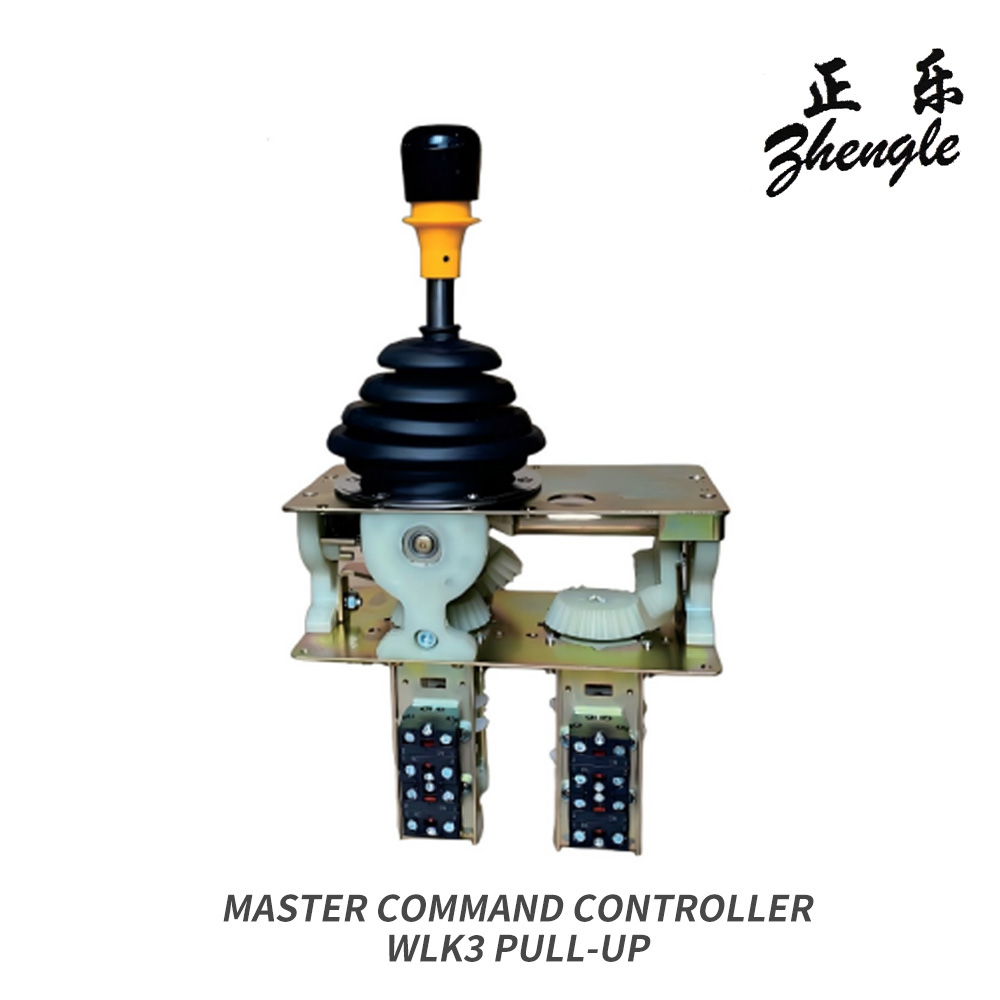
Five steps give five fixed speeds at roughly 20%, 40%, 60%, 80% and full speed, for the lowest possible panel cost. Stepless control gives any speed from about 5% upward, and pays for itself only when the crane starts often or has to land a load within a few millimetres. The number that decides between them is not rated capacity — it is starts per shift multiplied by positioning tolerance.
Most inquiries we receive frame this as a budget question. It is really a duty-cycle question, and the arithmetic below is what we walk through with buyers before quoting: what each step actually buys, where the extra cost of a drive comes back, and the four duty profiles that make the choice obvious.
If you are still deciding between handle types at the same time, the two questions are independent — the step decision drives the panel, the handle decision drives the cab — but they are usually settled in the same meeting. This is the working version of 5-step vs stepless master controller for crane speed control — the numbers that get used in real quotations rather than the marketing version, and the same arithmetic that sits behind every Master Controller specification we issue.
1. What Do Five Steps Actually Buy You?
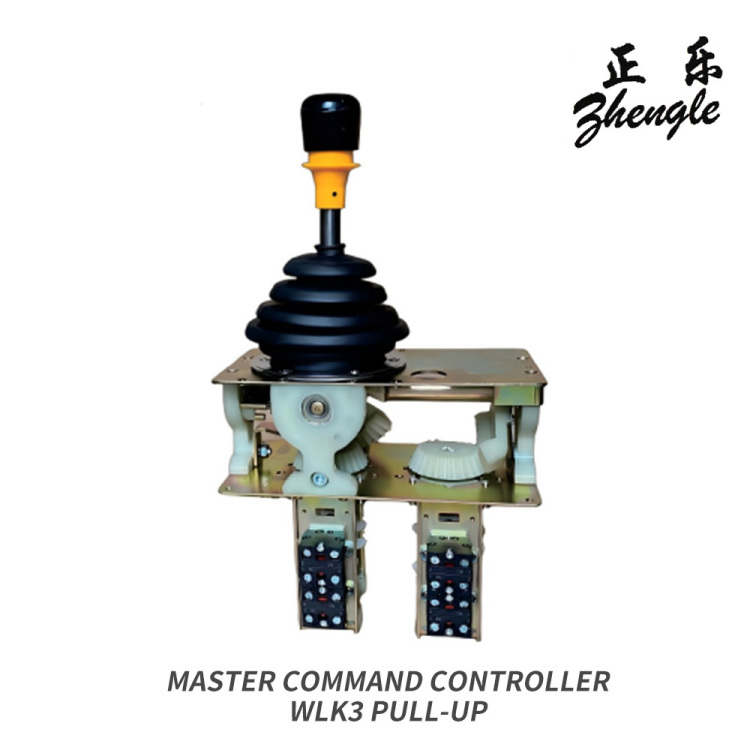
Each step removes one stage of rotor resistance, so five steps means five speed plateaus and four intermediate stages between standstill and full speed. The plateaus are fixed by the resistor bank. The operator cannot ask for 47% speed; the crane will only give 40% or 60%.
That has three consequences a specification has to live with:
- Positioning accuracy is set by the first step, not the last. With all resistance in circuit, a slip-ring hoist runs at 20–25% of rated speed. On a 0.5 m/s hoist that is 0.10–0.12 m/s — fine for a container yard, too coarse for a mould that has to land within 5 mm.
- Cycle time is set by the gaps between plateaus. Hoisting from 40% to 60% loses the time spent accelerating through a stage that cannot be modulated. On a 200-lift shift, that gap is worth 8–12% of total cycle time in our own timing tests.
- Load sway is set by how hard the transition is. A notch change is a step input to the load; a drive ramps it. On long travel with a spreader, that difference shows up as residual sway at the set-down point.
The table below is the short rotor resistance notching crane speed control guide we send with retrofit quotations, because it turns all three into something a maintenance planner can compare against their own cycle:
|
Step |
Speed vs rated |
Typical use on a hoist |
Positioning you can expect |
|
1 |
20–25% |
Taking up slack, landing |
±20–30 mm |
|
2 |
~40% |
Creep across a bay |
±10–15 mm |
|
3 |
~60% |
General transfer |
±15–20 mm |
|
4 |
~80% |
Approach to target |
±10 mm |
|
5 |
95–100% |
Long runs, empty return |
n/a |
A rotor resistance notching crane speed control guide written by a panel builder will tell you the same thing from the other side: the step count is a property of the resistor cabinet, and the handle merely selects it. Change the cabinet and the step count changes with it.
2. When Does Stepless Pay Back?
Stepless control pays back when the hoist starts often enough that the energy saved and the brake wear avoided exceed the price difference of the drive. On a VFD the motor runs at reduced slip instead of burning slip power in a resistor, and the saving scales with the number of starts, not with the tonnage moved.
The measured range from our retrofit projects is 15–40% of hoist energy, with the high end on cranes that start more than 300 times a shift and the low end on cranes that make a handful of long runs. Three further effects usually matter more to the buyer than the electricity:
- Brake life. Dynamic braking through the drive removes most of the mechanical stopping duty from the brake, and brake relining intervals on stepless hoists typically stretch by two to three times.
- Creep speed. A drive holds 5% of rated speed indefinitely without overheating a resistor, which is what makes ±3 mm positioning possible on a 0.5 m/s hoist.
- No resistor heat. In a foundry or a closed cabin, removing the resistor cabinet removes a heat source and a dust trap at the same time.
That saving is the whole of the 5-step vs stepless master controller for crane speed control calculation, and the only part that moves with site conditions. Against it, four costs are real and usually left out of the brochure comparison: the drive itself, the encoder or potentiometer handle, the motor derating for VFD duty, and the panel space. A retrofit on a 20 t hoist that starts 200 times a shift typically lands at 18–30 months payback on energy and brake savings alone, before any productivity credit — which is why ZhengQi asks for starts per shift before quoting either option.
|
Criterion |
5-step notched |
Stepless (VFD) |
|
Capital cost |
Baseline |
+30–60% on the hoist drive package |
|
Speed range |
5 fixed plateaus |
5% to 100%, continuous |
|
Positioning |
±10–30 mm |
±3–5 mm |
|
Energy, frequent starts |
Baseline |
15–40% lower |
|
Brake reline interval |
Baseline |
2–3× longer |
|
Resistor cabinet |
Required, generates heat |
Eliminated |
|
Retrofit complexity |
Handle and panel only |
Drive, motor check, encoder, panel space |
|
Best fit |
Fixed cycles, generous tolerance |
High starts, tight tolerance, heat-sensitive bay |
3. How Many Steps Does an Overhead Crane Controller Need?
Three steps cover most general-duty cranes, five steps cover cranes that must place loads precisely, and stepless covers cranes whose cycle repeats hundreds of times a shift. Capacity barely enters the decision; the two variables that matter are lifts per shift and the tolerance at the set-down point.
The four profiles below account for most of the cranes in service, and each one has an answer that has held up across our export orders:
- Workshop crane, under 10 t, fewer than 100 lifts a shift, tolerance ±50 mm. Three steps. Five adds a plateau the operator will not use and a stage the panel has to pay for.
- General overhead crane, 10–50 t, 100–300 lifts a shift, tolerance ±20 mm. Five steps, with the first step sized for creep. This is the volume specification worldwide and the reason 5-step handles dominate catalogues.
- Ladle, grab, container or mould handling, tolerance ±5 mm or a swinging load. Stepless on hoist. Keep notched control on long travel if the duty is simple — mixed panels are normal and cheaper than full VFD.
- Existing crane, resistor bank in good condition, occasional use. Keep the step count and change nothing except worn contacts. A VFD retrofit on a crane that runs twice a day buys nothing.
Two field notes belong with that list. First, in a cabin the hoist and travel handles are assembled into one Linkage Console at a single reach, and it is entirely normal for the hoist side to be stepless while the travel side stays notched — the console drawing has to show both. Second, step count is often written on the panel drawing as a fraction of the resistor stages, so confirm the two agree before ordering either the handle or the cabinet.
Zhejiang Zhengqi Electric Co., Ltd. supplies both routes from the same factory — cam handles from 1-0-1 through 5-0-5, and electronic handles with analog, encoder, Grey code or CAN output used for Lifting Equipment in ports, steel plants and construction sites — so the comparison above is quoted on the same basis, not from two different suppliers.
✅ Bottom line: Count starts per shift and measure the tolerance at the set-down point; if both are demanding, go stepless, and if only one is, change the step count instead.
FAQ
Q: Can I convert a 5-step crane to stepless without changing the handle? A: Sometimes. A cam handle can feed a multi-step input card as a stepped reference, which gives the drive five discrete speeds — not stepless control. Real proportional control needs a potentiometer, encoder or Hall-effect handle, and the panel needs the matching input.
Q: Is a 3-step crane cheaper to run than a 5-step one? A: Slightly, because it has fewer contactors and less resistor hardware to maintain, but the difference is small next to the duty cycle. The mistake to avoid is ordering three steps for a crane that needs creep; the operator then lands loads on the first step, which is the slowest and most abusive way to run a hoist.
Q: In one line, what is the 5-step vs stepless master controller for crane speed control trade-off? A: Five steps buy fixed speeds at the lowest panel cost, while stepless buys any speed and the energy and brake savings that come with it — the choice is decided by starts per shift and tolerance, not by capacity.
Send the Duty Cycle, Get Both Options Priced
Send the crane type, capacity, lifts per shift, travel distance and the tolerance at the set-down point, and ZhengQi prices the notched and the stepless route side by side, with the payback arithmetic shown rather than asserted. Buyers who are unsure how many steps does an overhead crane controller need for a mixed fleet get a one-page matrix covering every crane on site, so the same answer is not re-litigated per machine. Zhejiang Zhengqi Electric Co., Ltd. runs OEM and ODM programs from a single unit upward, builds custom step codes without new tooling, and ships wiring diagrams with every order. Sampling before a bulk order is standard, and retrofit inquiries get the resistor-stage check before the quotation, not after.
Mobile: +86 15957633222