
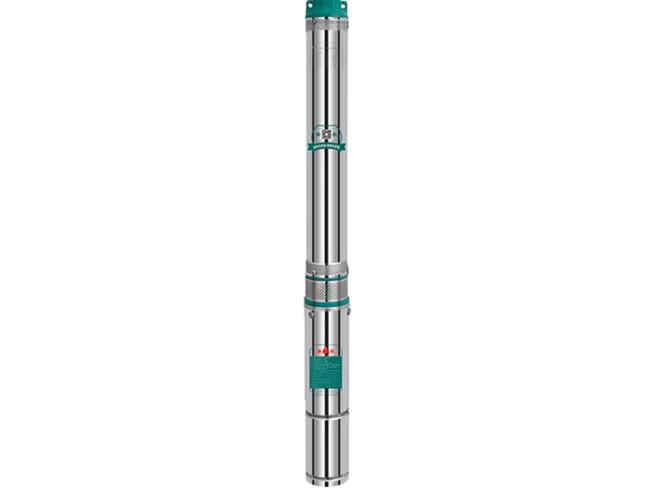
Measure the casing's inner diameter before anything else — the well casing, not the price list, decides between a 3-inch and a 4-inch pump. A 4-inch unit is the mainstream choice for new wells, but a 3 inch borehole submersible pump for narrow well casing situations — old steel wells, slim boreholes, low-yield aquifers — is often the only fit that actually goes down the hole. The comparison below is how Jinbu briefs distributors who stock both sizes in their Deep Well Pump programs.
1. When Does a 3-Inch Borehole Pump Make Sense?
Reach for the 3-inch frame when the casing's inner diameter is under 100 mm, or when the well yields very little water. Thousands of older steel-cased wells — drilled decades ago with 80–90 mm tooling — simply cannot swallow a 4-inch pump, and re-drilling the well costs far more than downsizing the pump. A 3 inch borehole submersible pump for narrow well casing jobs also suits low-yield aquifers, where a big flow rating would just pull the well dry and cook the motor.
How the two frames compare:
|
Spec |
3-Inch Pump |
4-Inch Pump |
|
Actual pump OD |
2.9–3.1 in (74–82 mm) |
3.8–4.0 in (96–102 mm) |
|
Minimum casing ID |
90–100 mm |
105 mm+ (5–6 in ideal) |
|
Typical flow range |
1–5 m³/h |
1–10+ m³/h |
|
Power range |
0.5–1.5 HP |
0.5–10 HP |
|
Cost per unit of flow |
Higher |
Lower |
|
Best fit |
Old or slim casings, low-yield wells |
New wells, mainstream supply |
Two trade-offs sit behind the table:
- ✅ The 4-inch frame wins on economics — more flow per dollar, a wider horsepower ladder, and far more service parts on the market.
- ✅ The 3-inch frame wins on fit and water discipline — it goes where nothing else fits, and its small flow rating protects low-yield wells from over-pumping.
One more purchasing note: most 3-inch demand comes from replacement markets in Europe, the Middle East, and South Asia, while 4-inch frames dominate new drilling in Africa and the Americas — stocking both frames lets a wholesaler serve retrofit and new-build channels from the same inventory.
✅ Bottom line: Choose the 3-inch frame when casing ID is under 100 mm or well yield is low; otherwise the 4-inch frame delivers more flow per dollar with deeper HP options.
2. What Should Installers Check Before Ordering Either Size?
Three checks separate a smooth installation from a pump that never comes back up: clearance, cooling flow, and the specs on the datasheet.
Clearance first. A pump labeled "3-inch" actually measures 2.9–3.1 inches across the body, and every installation needs at least a 1/4-inch gap for the cable and safety rope — so a 100 mm casing realistically fits a 76–86 mm pump body, not a 90 mm one. That measurement, not the marketing name, is the heart of any honest 3 inch vs 4 inch submersible well pump comparison for well casing: start with the tape measure, then read the datasheet's OD line.
Cooling second. Submersible motors shed heat through water flowing past them; industry practice keeps the annular flow velocity at or above 0.15 m/s. Squeeze an oversized pump into a tight casing and the film of cooling water disappears — the motor overheats long before its rated life, even though nothing was "wrong" with the pump itself.
Specs third. When reading 4 inch submersible well pump 1hp single phase specs, the three lines that matter are rated head at duty flow (never the max-head figure), stage count, and voltage tolerance — anything below ±10% of nameplate voltage sags output and heats the windings on long cable runs.
Two site conditions reshape the choice:
- Water duty. Both sizes assume clean water with sand content under 0.25%. Solids-laden wastewater is a different product class — that specification calls for a Sewage Pump Cutter Pump, where the cutter impeller, not the casing fit, does the work.
- Power source. Match the winding to the supply — 110V lines behave differently from 220–240V at depth. Off-grid sites pairing the pump with a Solar Pump system should size the frame for daily volume rather than peak flow, which keeps the panel array smaller.
✅ Bottom line: Verify the casing ID leaves room for cable and rope beside the pump, keep water moving past the motor for cooling, then match the curve to depth — in that order.
FAQ
Q: When should I order a 3 inch borehole submersible pump for narrow well casing instead of a 4-inch model?
A: When the casing ID is under 100 mm, when the well is an old steel-cased hole that cannot be re-drilled cheaply, or when a low-yield aquifer needs a small, disciplined flow. A proper 3 inch vs 4 inch submersible well pump comparison for well casing always starts with the tape measure, not the price list.
Q: Which lines matter most when checking 4 inch submersible well pump 1hp single phase specs?
A: Rated head at the duty flow, stage count, voltage tolerance, and the pump's outside diameter. Ignore the max-head line — it is the zero-flow point — and never order without confirming the OD against the casing.
Q: Can Jinbu supply both sizes under one program?
A: Yes. Jinbu — full name Zhejiang Jinbu Pump Technology Co., Ltd. — manufactures 3-inch, 4-inch, and 6-inch borehole pumps with OEM stage counts, voltage options, and private-label branding. MOQ starts at 100 units per model, with sample orders for first-time wholesale buyers.
Send Us Your Casing Diameter First
Measure the well casing's inner diameter and note the depth, dynamic water level, and target flow — Jinbu engineers will match a 3-inch or 4-inch frame to the hole and return an OEM quote with the duty-point curve within 48 hours. Factory pricing and free selection support for distributors, straight from Wenling, China.