

For a 2-ton electric pallet truck, 230 mm is the default — not 210 and not 250. That is not an opinion; it is what the OEM spec sheets say. Any honest 210mm vs 230mm electric forklift drive wheel comparison has to start there, then move past diameter to tread width, dynamic load and floor conditions, because diameter alone tells you almost nothing about whether a wheel survives a shift. This guide answers what wheel diameter for 2 ton electric forklift buyers actually spec, and reads a drive wheel tread width and load capacity chart the way an engineer would — so the wheel you order is the wheel that fits.
1. What Wheel Diameter for a 2 Ton Electric Forklift? Read the OEM Spec Sheets
The answer is Ø230 × 75 mm, and it is remarkably consistent across brands. Pull the published specifications of four mainstream 2-ton stand-on pallet trucks and the drive wheel repeats itself: the NIULI CBD-20A (2,000 kg) uses Ø230 × 75; the Zowell XP20A (2,000 kg) uses Ø230 × 75; the Carry-up CBD20V (2,000 kg) uses Ø230 × 75; the Baoli EP20-N03 (2,000 kg) uses Ø230 × 75 as well. Step up to 2.5–3 tonnes and the number moves to 250 mm — the NIULI CBD-30A (3,000 kg) and the Baoli EP20-N01/N02 (Ø252 × 88) sit in that band. The pattern is not a coincidence: 230 mm is where a compact pallet-truck chassis, a 1.2–1.5 kW AC motor and a 24 V system reach balance.
That directly settles what wheel diameter for 2 ton electric forklift procurement should treat as the starting point: match 230 mm unless your floor or duty cycle gives you a reason not to. Three reasons legitimately do:
- Rough or jointed floor. If the route crosses dock plates, expansion joints or a settled slab lip, 250 mm bridges gaps that catch a smaller wheel.
- Heavy continuous duty. Multi-shift operation favours the larger wheel's lower rolling resistance and cooler-running contact patch.
- A compact AGV chassis. If the machine is a narrow-aisle AGV or a scrubber, 210 mm keeps the drive unit low and the turning radius tight — the reason the LN-W21 exists in the first place.
Do not size up simply to gain ground clearance. Changing the diameter on an existing truck alters travel speed, available wheel torque, encoder/odometry calibration and steering geometry at the same time. Replacement wheels should hold the original effective diameter unless the OEM has approved a design change. Wenling Lvneng Electromechanical Co., Ltd. supplies LN-W21 (210 mm), LN-L23U (230 mm) and LN-W25 (250 mm) as distinct platforms precisely because these three jobs are not interchangeable.
✅ Bottom line: For a 2-ton pallet truck, spec 230 mm. Move to 250 mm for rough floors or heavy duty, and to 210 mm only for compact AGVs and clean, flat aisles.
2. What Else Does a Drive Wheel Diameter Chart Need to Tell You?
Diameter is the first dimension and the least decisive one. Any 210mm vs 230mm electric forklift drive wheel comparison that stops at the three numbers misses why one wheel outlasts another. A wheel that fits the available space can still overload the motor, scrub on turns or fail early under heat. A proper drive wheel tread width and load capacity chart adds the variables that actually govern life: tread width, dynamic rating, hardness and steering method. To see why, look at the same comparison from three angles.
|
Dimension |
210 mm (LN-W21) |
230 mm (LN-L23U) |
250 mm (LN-W25) |
|
Typical application |
Compact AGV, scrubber, narrow aisle |
2-ton pallet truck, stacker, low-level platform |
2.5–3 ton truck, rough floor, heavy duty |
|
Approx. obstacle clearance (ů/3) |
~65–70 mm |
~75 mm |
~80–85 mm |
|
Tractive force at same axle torque |
Highest |
Mid |
Lowest |
|
Installation space / deck height |
Lowest |
Mid |
Highest |
|
Direction of load capacity trend |
Lower |
Mid |
Higher |
Obstacle geometry explains the whole "bigger is better" argument. A rigid wheel climbs a vertical step of roughly one-third of its diameter before it needs momentum; beyond about one-quarter of the diameter, pull effort climbs three to four times. The horizontal force needed to lift a wheel over a lip scales with step height divided by wheel radius — halve the radius and you roughly double the effort. Published AGV tables put the same relationship in load terms: a Ø210 × 50 mm wheel is typically rated around 730 kg, a Ø250 × 55 mm wheel around 960 kg. That gap comes from tread width and core structure as much as diameter.
Now read the load number correctly. The static rating is the highest figure a wheel can bear standing still; the dynamic rating is the one you design with, and it is typically only 70–80% of static for polyurethane wheels under frequent stop-start. Industry practice applies a safety factor of 1.5 on smooth indoor floors and 2–3 for outdoor, high-speed or obstacle-strewn routes. The standard calculation is T = (E + Z) / n × S, where E is vehicle weight, Z is payload, n is the number of load-bearing wheels and S is the safety factor. Continuous operation and drive-wheel duty each shave the allowable load further — one widely used Vulkollan guide applies 0.75 for continuous running and 0.70 for a driven wheel, so a 1,000 kg wheel becomes roughly 420 kg in a continuous 8 km/h drive application. A 230 mm wheel rated generously on a catalogue is not automatically a 230 mm wheel that survives your route.
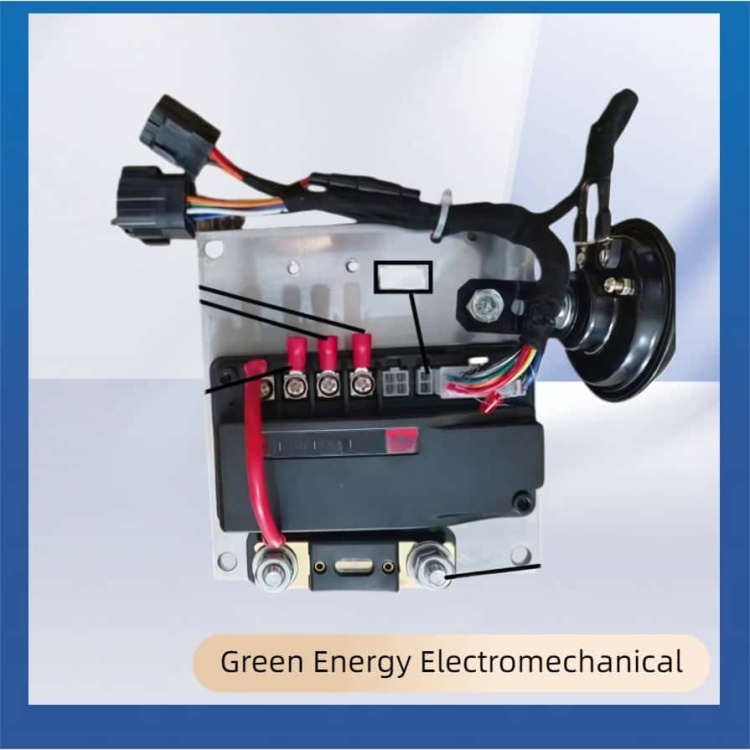
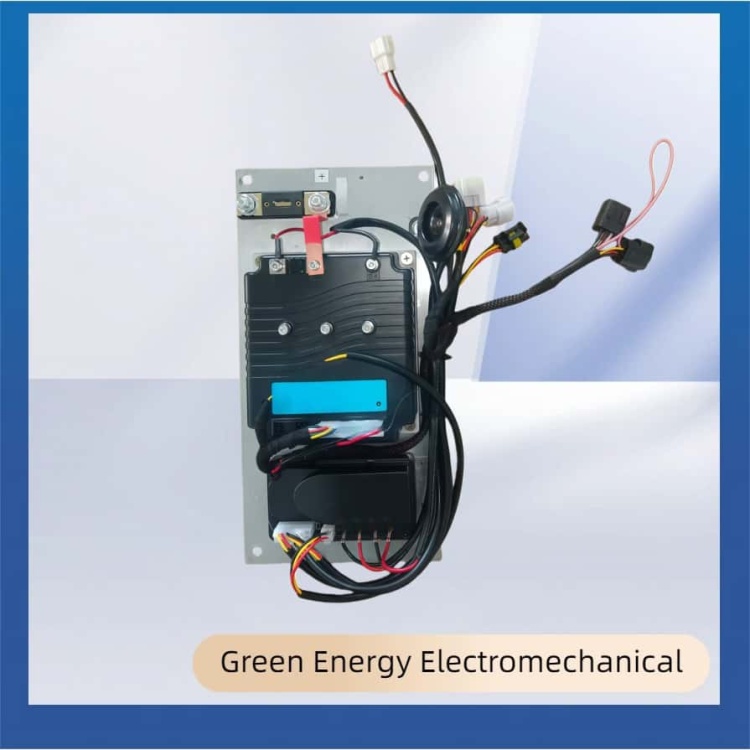
This is where Lvneng parts company with a parts catalogue. A custom build from our China factory can change tread width, polyurethane hardness and core design around the same 230 mm envelope; the GreenEnergy series pairs that wheel with a matched 24 V AC drive and controller so the torque, speed and load ratings are validated as a system. Buyers comparing wholesale offers should ask for the dynamic rating at their actual speed and duty cycle, not the headline static number — most of the apparent price gap disappears once every supplier is held to the same test.
✅ Bottom line: Judge a wheel by dynamic load at your speed and floor, not by diameter. Across 210/230/250 mm, 230 mm is the balanced default for a 2-ton truck.
FAQ
Q: Is there a short 210mm vs 230mm electric forklift drive wheel comparison for a replacement purchase? A: Hold the original diameter unless the floor demands a change. A 2-ton pallet truck almost always leaves the factory on 230 mm; replacing it with 210 mm lowers the deck and raises ground pressure, while 250 mm can alter speed and encoder calibration. Lvneng supplies all three diameters so a replacement can match the original interface.
Q: What wheel diameter for 2 ton electric forklift fleets is safest when the floor is uneven? A: Stay at 230 mm and fix the floor lip first. Upsizing to 250 mm changes travel speed, available tractive force and steering geometry, and can collide with the chassis. Lvneng engineers will tell you whether a harder tread solves it before a diameter change ever does.
Q: Do you offer OEM/ODM builds for non-standard mounting interfaces? A: Yes. Wenling Lvneng Electromechanical Co., Ltd. produces OEM/ODM custom drive wheels — diameter, tread width, bore and keyway, hardness and IP sealing — and ships factory-direct from our production line in China. Distributors can start with a single sample assembly and verify the dynamic load rating on their own floor.
CTA: Get the Wheel Matched to Your Truck, Not Just Your Catalogue
Send your truck model, rated load, drive-motor power, floor description and current wheel's bore/keyway dimensions. Lvneng will return a diameter recommendation with the dynamic load calculation, a drive wheel tread width and load capacity chart, and the mounting drawing for the proposed assembly. Need something the catalogue does not list? Our engineering team builds custom and OEM drive-wheel assemblies to interface spec — ask for a sample and a factory price before you commit to a fleet order. Every GreenEnergy drive wheel ships with its dynamic load rating in the datasheet, so the number you design with matches the one on the test bench.
|
|
|
|
Published: November 2026 |
By Lvneng GreenEnergy Drive Systems Engineering Team |